

OKUN · Installation Guide
How to Install Linear HVAC Diffusers the Right Way
The complete guide to measuring, mounting, and fine-tuning a linear diffuser — with the official OK50 diagrams, a sizing chart, and an honest look at how OKUN compares to commercial slot systems and builder-grade linear AC vents.

Quick Answer
How do you install a linear HVAC diffuser?
A linear HVAC diffuser installs over an existing duct opening in under 10 minutes: verify the size against the duct opening (not the old cover), test-fit the grille, open the airflow blades, then secure it with the four included screws and a Phillips-head screwdriver. OKUN's concealed-mount design hides the fasteners behind the face — no visible screws, no duct modification, no professional HVAC work.
"The little details make a big difference in how a space feels."
Overview
What Is a Linear HVAC Diffuser — and Why Swap Yours?
Your vents were never meant to be looked at. Builder-grade registers — stamped steel, two visible screws, a finish that yellows — are installed to be forgotten. In a room with clean lines, they're the one thing your eye keeps snagging on.
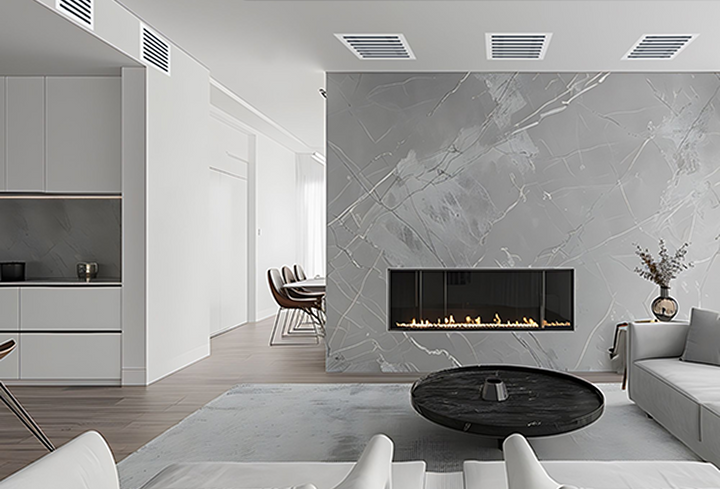
Linear HVAC diffusers solve that. An elongated slot profile replaces the clunky rectangle, adjustable horizontal blades sit behind the face to direct airflow, and the fasteners disappear entirely. You'll see the same product family called a linear bar grille, a linear slot diffuser, or simply linear AC vents — the terms overlap, and the differences are mostly face styling.
OKUN's linear grille line is built from commercial-grade, rust-resistant aluminum in a powder-coated matte white finish. It works as both supply and return, mounts on walls or ceilings, and installs over the duct opening you already have.

The OKUN Look
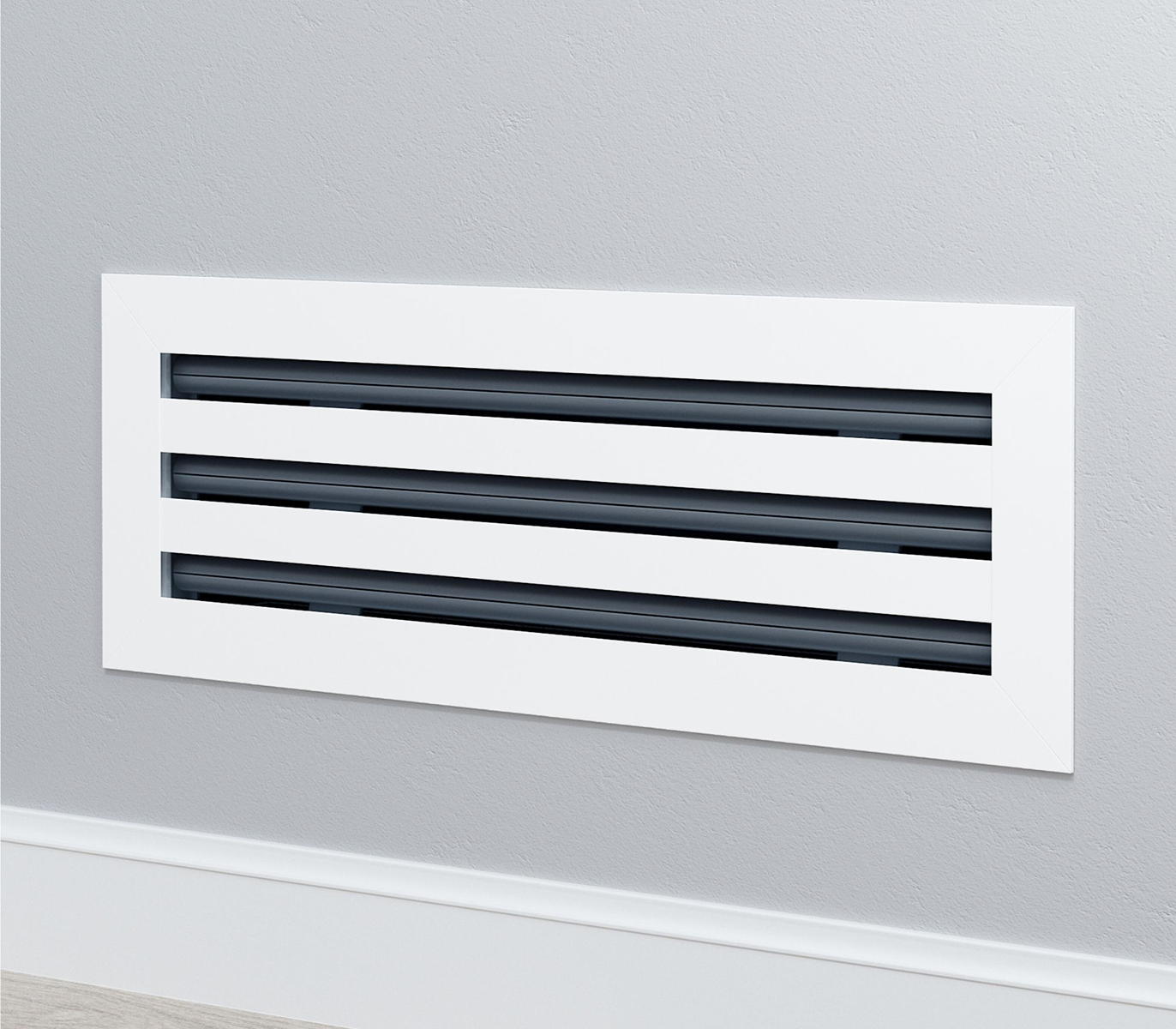
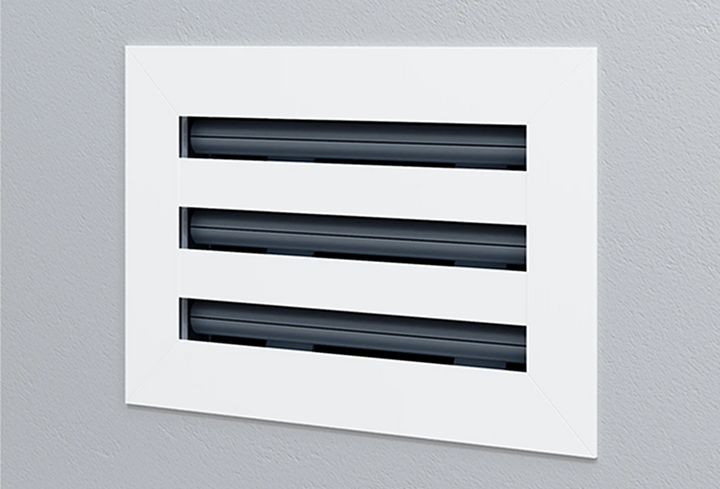
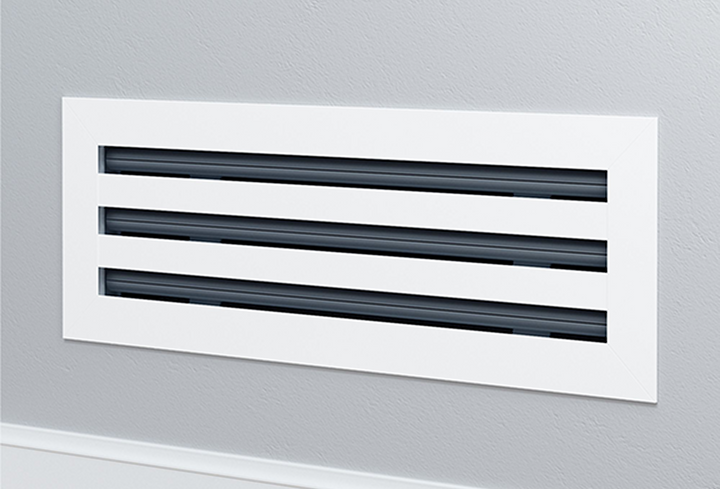
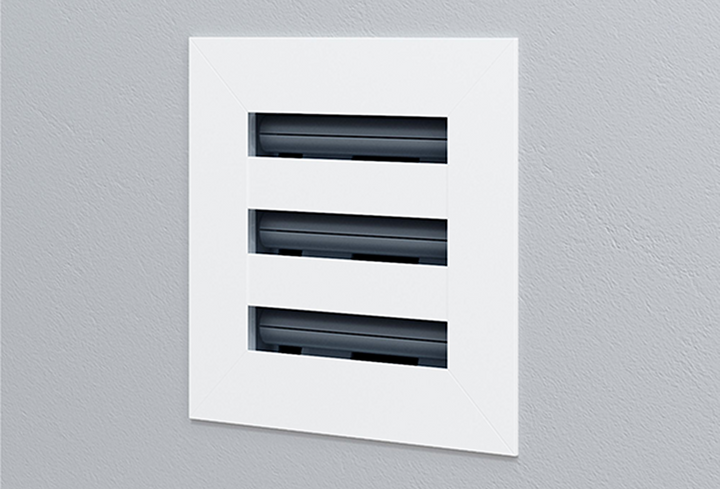
Matte White Frame, Black Louvers
Most vent covers fail aesthetically in one of two ways: shiny painted steel that glares under ceiling light, or an open register that reads as a hole in the wall. The OKUN linear grille is designed around a deliberate two-tone contrast that solves both.
The matte white finish
The frame is powder-coated matte white over commercial-grade aluminum — not paint over steel. Matte white is the finish that disappears: it matches the most common wall and ceiling color in American homes, diffuses light instead of reflecting it, and hides dust and fingerprints far better than gloss. Because it’s a bonded powder coat on a metal that can’t rust, it won’t yellow at the edges, bubble from condensation, or chip the way painted builder-grade vents do — the failure you’ve seen on every old bathroom register.
The black louvers
Behind the white slots sit the black louvers — the adjustable horizontal blades that control your airflow. The dark blades recede into shadow, so instead of seeing ductwork through the openings, you see a crisp dark line framed in white: the same visual language as a shadow-gap reveal in architectural millwork. Function-wise, those louvers tilt with any household tool to direct air, throttle it, or shut it off entirely.
A style you won’t find at the hardware store
The rest of the design follows the same restraint: a slim beveled frame, a flush face, and a concealed mount with zero visible screws — the detail that most clearly separates architectural grilles from stamped covers with two screws staring at you from the wall. The result belongs in the room the way trim and hardware do. And because the same look carries across OKUN’s linear, standard, and square grille lines, supply runs, returns, and odd-sized openings all match through the whole home.
Before You Order
Measuring — the Step Everyone Gets Wrong
The single most common ordering mistake with linear HVAC diffusers: measuring the old vent cover instead of the hole behind it.
Vent covers are sized by duct opening — the actual cutout in your wall or ceiling. The faceplate is deliberately larger so it overlaps the drywall and hides the rough edge. On OKUN linear grilles, the face runs roughly 2 inches larger in each dimension: a 10" × 4" grille carries an 11.8" × 5.9" faceplate with a 1.8" mounting depth.
So: unscrew the old cover, measure the exposed opening's width and height, and order that size. If the opening has been painted over, shimmed, or cut irregularly, measure the actual cutout at its true edges before ordering.

Step by Step
Installation in Seven Steps
This is the exact sequence from the OK50 installation manual (included in every box, and here as a PDF), with the official diagrams. Before you begin: switch the HVAC system off at the thermostat so air isn't blowing while you work.
Check measurements & included parts
Verify the grille dimensions align with your existing vent opening (or the designated opening in new construction), and confirm everything is in the box: the grille and the mounting screws.

Measure the vent opening
Measure carefully: the grille's inner body (A × B) must fit inside the opening with adequate depth (W), while the faceplate (C × D) fully covers the cutout for a clean, finished look.
Old cover painted into the wall? Score around its edge with a utility knife before removal so the drywall paper releases cleanly.

Fit the grille
Gently place the grille into the air conditioning or return opening to check the fit. It should slide toward the opening without force.

Confirm the fit
If the grille sits smoothly and securely against the surface, you're clear to proceed. The faceplate should overlap the cutout on all sides with no gaps.
On long runs, "level to the room" beats "level to the bubble" — your eye compares the grille to the nearest door casing or ceiling line, not to true horizontal.

Open the airflow blades
Before mounting, use a small household tool — a screwdriver works, so do fingers — to adjust the horizontal blades. Push them toward the center, leaving even gaps on both sides for optimal airflow.

Mount the grille
Using the four included screws and a household Phillips screwdriver, secure the grille to the vent or return opening. Snug is the goal — overtightening into drywall strips the hole and can bow the frame.

Enjoy the result
Turn the system back on and fine-tune the blades — toward the center of the room, away from a bed or desk, or closed down to throttle a room that runs cold. What's left on your wall is an uninterrupted line of matte white.
Supply vent blowing straight at a thermostat? Angle the blades away — it stops the system from short-cycling on false readings.

Sizing
Six Sizes, One Standard
All sizes share the same matte white aluminum, concealed mount, and adjustable blades — sized by duct opening, with free 3–5 day delivery, from $40.90.
| Duct opening | Faceplate (approx.) | Best for |
|---|---|---|
| 10" × 4" | 11.8" × 5.9" | Bedrooms, offices, standard supply runs |
| 12" × 4" | ≈14" × 6" | Standard supply runs, hallways |
| 14" × 4" | ≈16" × 6" | Living areas |
| 16" × 4" | ≈18" × 6" | Larger rooms, longer wall lines |
| 20" × 6" | ≈22" × 8" | High-volume supply, open-plan spaces |
| 30" × 6" | ≈32" × 8" | Feature runs, returns, great rooms |
For context: builder-grade stamped steel typically runs $10–$20 (and rusts), while architectural custom diffusers commonly start north of $100 per unit before installation.
Side by Side
OKUN vs. the Alternatives
If you've researched linear diffusers, you've met the engineered commercial slot systems found in offices, lobbies, and high-end commercial builds. They're excellent at what they're built for. The question is whether what they're built for is your hallway.
| Feature | OKUN Linear | Commercial Slot Systems | Builder-Grade Steel |
|---|---|---|---|
| Designed for | Homes & light commercial | Commercial, engineer-specified | Tract housing, cost-first |
| Typical price | From $40.90 | Custom-quoted; typically $100+ per unit + pro install | $10–$20 |
| DIY installation | ✓ Screwdriver, <10 min | ✗ Professional; often needs a plenum | ✓ Basic |
| Fits existing duct opening | ✓ Direct replacement | ◐ Usually needs modification | ✓ |
| Ordering | 6 standard sizes, 3–5 day delivery | Custom lengths, project lead times | Off the shelf |
| Material | Rust-resistant aluminum | Aluminum (commercial spec) | Stamped steel — can rust |
| Visible screws | ✓ None — concealed mount | ◐ Frame-dependent | ✗ Two, front and center |
| Airflow adjustment | ✓ Blades, any household tool | Engineered patterns, spec-dependent | ◐ Basic damper, if any |
✓ Fully supported · ◐ Partial / limited · ✗ Not available · Based on publicly available specs.
The honest summary: commercial slot systems are the right call when an engineer is speccing continuous slot runs into a new commercial ceiling with a plenum behind it. Builder-grade is the right call when the only criterion is price. OKUN sits in the gap — the architectural slot aesthetic and rust-proof aluminum of the commercial world, in standard residential sizes that screw straight over the duct opening you already have.

Glossary
Key Terms Defined
Linear slot diffuser
An elongated vent with narrow slot openings and blades set behind the face. The architectural standard for continuous supply lines in modern interiors.
Linear bar grille
A long, narrow vent with visible parallel bars across its face. In residential use, the term is largely interchangeable with slot diffuser.
Duct opening
The actual cutout in the wall or ceiling that the vent serves. Grilles are sized by duct opening — never by the old cover's outer frame.
Concealed mount
A mounting design that hides fasteners behind the grille face, leaving no visible screws on the finished surface. Standard on all OKUN grilles.
Supply vs. return
Supply vents deliver conditioned air into the room; returns pull it back to the system. OKUN linear grilles are dual-function and work on both.
Plenum
A pressurized air chamber behind commercial slot diffusers that evens out airflow along the slot. Required by many commercial systems; not needed for OKUN's residential replacement installs.
Common Questions
Frequently Asked Questions
Can I really install a linear HVAC diffuser myself?
Yes — four screws and a Phillips screwdriver, in under 10 minutes.
That's for replacing an existing vent with a grille sized to the same duct opening. Professional help only enters the picture if you're cutting a new opening or modifying ductwork.
Supply or return — which vents can I use these on?
Both — OKUN linear grilles are dual-function.
On supply runs, the adjustable horizontal blades direct and throttle conditioned air. On returns, air flows back through the same slot face. Same grille, either job.
Do linear grilles work on ceilings?
Yes — walls and ceilings both. Floors, no.
The concealed-mount design sits flush against either surface. This wall/ceiling model isn’t engineered for foot traffic — for floor ducts, OKUN offers a dedicated linear floor/wall vent cover in the same matte white line.
What's the difference between a linear bar grille and a slot diffuser?
Mostly face styling — the terms largely overlap.
A bar grille shows parallel bars across its face; a slot diffuser presents narrow openings with blades tucked behind. OKUN's design combines them — slot profile in front, adjustable blades behind — so it answers to either name.
Why aluminum instead of steel?
Condensation — steel rusts at the vent boundary; aluminum doesn't.
Vents live where conditioned air meets room temperature, and stamped steel rusts there — especially in bathrooms, kitchens, and cold AC supply runs. Rust-resistant aluminum with a powder-coated matte white finish resists corrosion, yellowing, and chipping over years of use.
Will a linear diffuser change my airflow?
It distributes air along a line — and gives you per-room control.
The slot face spreads air rather than dumping it from a rectangle, and the adjustable blades let you aim or restrict flow. Many people use the swap to finally balance rooms that run hot or cold: blades open in the starved room, closed down in the overcooled one.
How does OKUN compare to commercial slot diffuser systems?
Commercial systems are engineer spec; OKUN is the residential path to the same look.
Commercial spec means custom lengths, engineer drawings, professional installation, and typically a dedicated plenum — cost and lead time far beyond a home project. OKUN delivers the architectural slot aesthetic in six standard sizes from $40.90, installing over your existing duct opening the same afternoon it arrives.
Why choose a matte white finish for vent covers?
Matte white is the finish that disappears into the wall or ceiling.
It matches the most common surface color, diffuses light instead of glaring, and hides dust better than gloss. OKUN’s version is a powder-coated, fade-resistant finish over rust-resistant aluminum — no yellowing, chipping, or corrosion, even in bathrooms and kitchens.
What do the black louvers actually do?
They’re the adjustable blades — and the signature look.
Functionally, the black louvers behind the face tilt with any household tool to direct, throttle, or fully shut off airflow. Visually, the dark blades recede into shadow behind the white slots, creating a crisp two-tone line instead of a view into open ductwork.
What if my duct opening isn't a standard size?
Measure the true cutout first — many "odd" openings are standard sizes hiding under paint or shims.
If it's genuinely between sizes, size to the nearest duct opening; the oversized faceplate typically still covers the cutout. When in doubt, contact OKUN with your measurements before ordering.
Shop the Collection
Details That Make Every Home Feel Special
Six sizes. Matte white aluminum. No visible screws. Free 3–5 day delivery — and a screwdriver is all it takes.
Shop Linear Grilles Explore All Grilles