

OKUN · Style Guide
Doors and Handles: Matching Finishes Like a Designer
Which handle finish belongs on a white door? An oak one? A moody navy one? The complete style guide: every popular door finish matched to the right OKUN finish and lever shape, the three pairing strategies designers actually use, and what European minimalist design does for a modern home.

Quick Answer
Which door handle finish should I choose?
Matte black for white and light-wood doors (maximum contrast, the modern default). Brushed nickel for gray, walnut, and transitional interiors (the universal neutral). Chrome for high-gloss white, bathrooms, and high-contrast minimalist spaces. Brushed champagne gold for warm whites, creams, and natural woods. When in doubt: pick one finish and run it through the whole home — cohesion beats novelty.
“The little details make a big difference in how a space feels.”
Surface & Finish
Four Finishes, One Standard
Every OKUN collection comes in the same finish family, PVD-coated so the color is bonded to the metal rather than painted on. That’s what lets a finish survive twenty years of hands. Here’s each one’s personality:
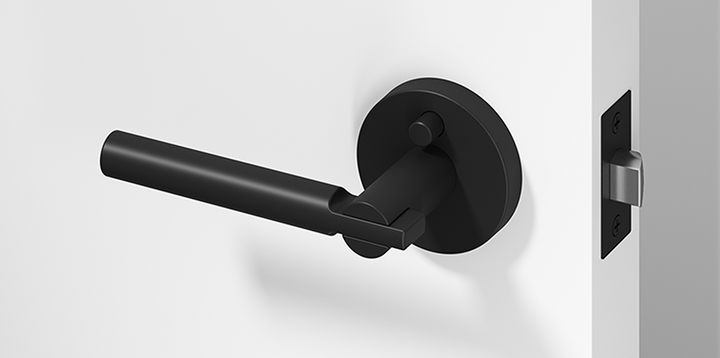
Matte Black
Ink on the page. A flat, light-absorbing black that turns every lever into a drawn line — and quietly links your doors to the black window frames, fixtures, and lighting the rest of the room is already wearing.
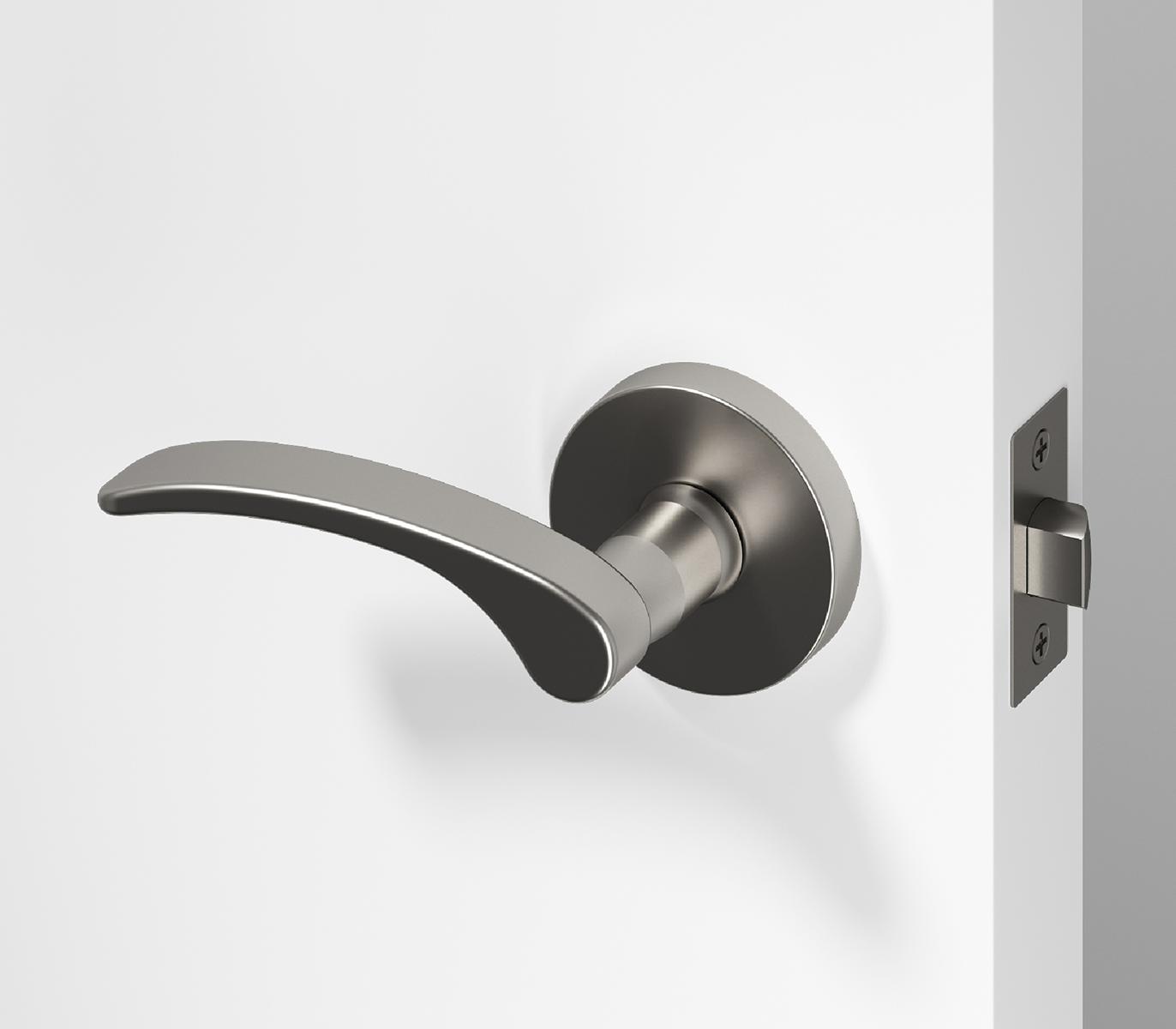
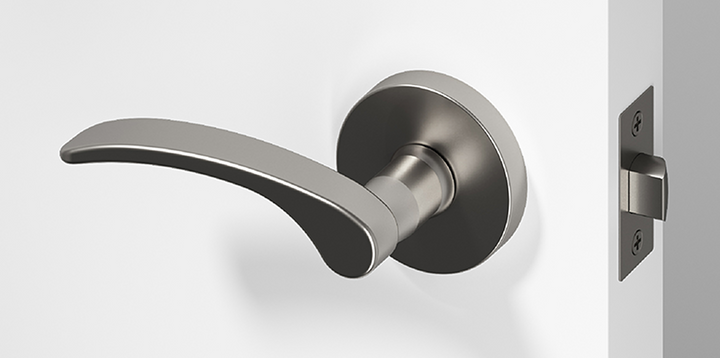
Brushed Nickel
The diplomat of the palette. A soft, cool sheen that gets along with every era and material a real home collects — which is exactly why it’s the finish to choose when nothing else in the house agrees.
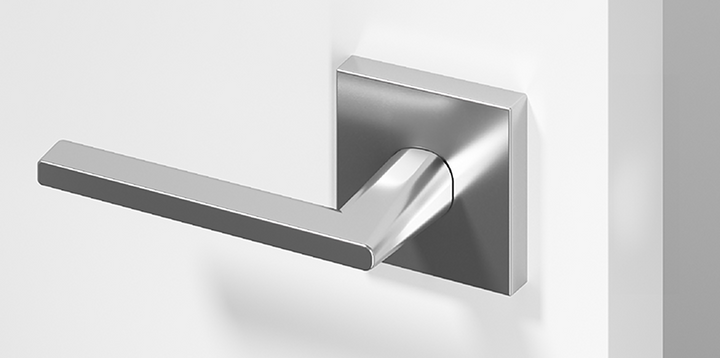
Polished Chrome
Light made solid. Chrome reflects the room back at itself, sharpening gloss doors, tiled baths, and strict black-and-white schemes — the finish for interiors that run on precision.
Brushed Champagne Gold
Warmth without the flash of polished brass. A muted, brushed gold that flatters cream walls, warm woods, and soft lighting — the finish for rooms designed around warmth.

The Pairing Guide
Match the Handle to the Door
The door is the biggest color block in the pairing, so start there. This is the matrix designers actually use — first choice, then the alternate that changes the mood:
| Door finish | First choice | The alternate | Why it works |
|---|---|---|---|
| Classic white | Matte Black | Champagne Gold | Black on white is the cleanest graphic contrast in interiors; gold softens the same door toward warmth. |
| High-gloss / lacquered white | Chrome | Matte Black | Gloss wants a finish that plays with light — chrome mirrors it; matte black anchors it. |
| Natural oak / light wood | Matte Black | Champagne Gold | The Scandinavian pairing: pale grain plus black geometry. Gold leans the same door Japandi-warm. |
| Walnut / dark wood | Brushed Nickel | Chrome | Cool metal keeps rich grain from going heavy; chrome adds a crisper edge in modern rooms. |
| Gray / greige | Brushed Nickel | Matte Black | Nickel harmonizes tone-on-tone; black turns a quiet gray door into a deliberate statement. |
| Navy / forest green | Champagne Gold | Matte Black | Deep saturated colors love warm metal; black keeps the same door strictly modern. |
| Black / charcoal | Matte Black | Brushed Nickel | Tonal black-on-black reads couture; nickel outlines the handle when you want it seen. |
| Cream / warm white | Champagne Gold | Matte Black | Warm whites want warm metal; black shifts the same door from soft to graphic. |
| Espresso / black-brown | Champagne Gold | Brushed Nickel | Gold glows against near-black wood; nickel keeps it quietly tailored. |
| Whitewashed / pickled oak | Matte Black | Chrome | Bleached grain is coastal-modern; black grounds it, chrome keeps it airy. |
| Glass / French doors | Matte Black | Champagne Gold | Against glass, the handle is a silhouette — choose the finish you want drawn in the air. |
One rule above all: repeat your choice. A finish used once looks like an accident; used on every door in sight, it looks like design.
Design Intelligence
The Three Pairing Strategies Designers Use
Every pairing in the tables above follows one of three moves. Name the move first, and the finish chooses itself:
1. Contrast — the modern default
Put the darkest element on the lightest surface: matte black on a white or oak door. Contrast makes the handle read as a drawn line — graphic, intentional, architectural. This is the strategy behind almost every modern interior you’ve saved to a mood board, and it’s the safest way to make builder-grade doors look designed.
2. Tonal — the quiet luxury move
Keep the handle within the door’s own temperature and value: nickel on gray, black on charcoal, chrome on gloss white. The handle almost disappears, and what registers instead is texture — brushed metal against painted wood. Tonal pairing is how minimalist and gallery-style interiors stay serene.
3. Warmth — the inviting counterpoint
Introduce a warm metal into a cool or neutral scheme: champagne gold on navy, cream, or natural wood. One warm note per door is enough — it catches lamplight in the evening and makes a hallway feel furnished rather than finished.
Pick one strategy per floor. Contrast upstairs and tonal downstairs can coexist; three strategies in one hallway cannot.
Form & Profile
Match the Lever Shape to the Door Style
Finish is only half the match. The other half is the lever’s geometry against the door’s construction — a flat lever on a flat door, a cylinder against panel lines. Each OKUN collection is one clear geometric idea, which makes this mapping simple:
| Door style | OKUN collection | Lever geometry | Why the shapes agree |
|---|---|---|---|
| Flush / slab (modern) | Valli | Slim flat rectangular | A flat plane deserves a flat lever — two clean surfaces, one language. |
| Shaker / two-panel | Zen | Slim tapered cylinder | The soft cylinder rounds off Shaker’s square frame without fighting it. |
| Multi-panel / transitional | Brio | Balanced cylinder | Even proportions hold their own against busier panel rhythm. |
| Tall / oversized modern doors | Halo | Elongated 5.25" taper | A longer lever keeps scale with an 8-foot door — standard levers look lost on them. |
| Curved openings / soft interiors | Arc | Curved profile | The lever’s curve echoes arched casings and rounded furniture. |
| Desert-modern / organic minimal | Dune | Straight cylinder, slight taper | Quiet geometry for interiors built on texture rather than line. |
All collections share the same 2 5/8" round rosette and 45° projection — so mixing lever shapes room-to-room still reads as one system, especially when the finish stays constant.
By Interior Style
Match the Handle to the Room
| Interior style | Finish | Collection character |
|---|---|---|
| Scandinavian | Matte Black | Slim cylindrical levers — serene, tapered shapes like Zen |
| Minimalist / gallery | Chrome or Black | Flat rectilinear profiles — the Valli’s clean lines |
| Japandi | Champagne Gold | Straight cylindrical warmth — desert-modern shapes like Dune |
| Modern farmhouse | Matte Black | Confident simple levers against painted paneled doors |
| Transitional | Brushed Nickel | Balanced proportions — versatile profiles like Brio |
| Contemporary / architectural | Black or Gold | Elongated tapered levers — the elevated 5.25" Halo |

Design Intelligence
What Makes the Design European
European hardware design descends from a simple conviction: a handle is architecture you hold, not decoration you attach. In the workshops that shaped modern European design, every curve had to earn its place — and on an OKUN door, that conviction becomes four concrete choices:
The lever, not the knob. Europe standardized on levers decades ago for good reason: a lever operates with a wrist, an elbow, or full hands of groceries. It’s ergonomics that happens to look better.
The compact round rosette. A 2 5/8" circular backplate instead of an ornate escutcheon. The rosette frames the lever the way a gallery mat frames a print — and disappears while doing it.
The honest profile. Slim rectangular (Valli), tapered cylindrical (Zen), curved (Arc), elongated (Halo) — each collection commits to one geometric idea and carries it without embellishment. When a pure shape meets a plain circle of metal, the eye reads intention; ornament could never say it as clearly.
The 45-degree projection. The lever meets the door at a considered angle — comfortable in the palm, consistent across the catalog, calibrated for daily contact rather than product photography.
For Homeowners
Why It’s the Smartest Upgrade in the House
Replacing every handle in a home costs less than replacing one door — and changes how every room reads. The case in four points:
1. Highest-touched, highest-noticed. No other object in a home gets handled as often as its doors. Dense, all-metal levers carry a reassuring heft and stay silent and rigid year after year — an upgrade you don’t see so much as feel, every single time.
2. Finishes built for decades. The PVD process fuses the color into the metal’s surface rather than layering it on top, so the finish outlasts ordinary plating by years: no bronzing in a steamy bathroom, no bare-metal wear spot where your thumb lands ten times a day.
3. Whole-home cohesion is actually affordable. Architect-grade hardware typically runs $80–$120 per handle, which is why most homes never get it. OKUN’s handles deliver the same design language at a fraction of that — with 2-packs and 6-packs for doing the whole floor at once.
4. A 15-minute, screwdriver-only job. Standard 2 3/8" and 2 3/4" backsets, doors 1 3/8" to 1 3/4" thick, fully reversible for left- and right-hand doors — and everything in the box: levers, adjustable latch, strike plate, hardware, Allen wrench, and the emergency unlock tool for privacy sets.

Common Questions
Frequently Asked Questions
What finish goes with white doors?
Matte black is the designer default — maximum contrast that reads as intentional.
Brushed nickel is the softer route for transitional rooms, and champagne gold warms a white door beautifully in cream-toned spaces.
Can I mix finishes in one home?
You can — but one finish throughout is what designers specify, and it’s the safest.
If you do mix, keep one finish per floor or zone and repeat each at least twice so it reads deliberate. Because OKUN runs the same finishes across all collections, you can vary handle shapes by room while the finish stays constant — the sophisticated version of mixing.
Do matte black handles show fingerprints?
Far less than glossy finishes.
Matte surfaces diffuse light, so smudges barely register compared with polished chrome or lacquered brass. The PVD coat also means daily contact won’t wear the color through to bare metal.
Should my handles match my hinges and other hardware?
Match the hinges; coordinate (don’t necessarily match) the rest.
Handles and hinges share the door, so keep them in the same finish. Lighting and plumbing can coordinate more loosely — matte black handles alongside warm brass lighting is a classic designer combination.
What makes a door handle “European” in design?
It’s a design philosophy, not a shipping label: the handle as held architecture.
You can spot it in four details — a lever rather than a knob, a small round rosette instead of a decorated backplate, one committed geometric profile, and nothing applied for show.
Will OKUN handles fit my existing doors?
Almost certainly — if your current handle came off a standard door, an OKUN goes on.
The adjustable latch covers both common backset sizes (2 3/8" and 2 3/4"), doors from 1 3/8" to 1 3/4" thick fit as-is, and every lever flips for either door swing. One screwdriver, everything in the box.
What’s the difference between privacy, passage, and dummy?
Think rooms, not mechanisms: privacy for doors that need to lock, passage for doors that just close, dummy for doors that only need a handle.
Bedrooms and baths take privacy (push-button lock, emergency release outside); hallways, closets, and pantries take passage; double doors and decorative panels take dummy. Every function ships in every collection and finish, so the choice never breaks your look.
What handle looks best on flush / slab doors?
A flat rectangular lever — the Valli profile.
Flush doors are a single clean plane, so the lever should be one too. In matte black on a white slab it’s the definitive modern pairing; in champagne gold it warms the same door for Japandi rooms.
What about Shaker doors — modern or traditional hardware?
Modern — a slim cylindrical lever bridges both worlds.
Shaker’s simple frame is already transitional; a tapered cylinder like the Zen keeps it current without clashing, in black for contrast or nickel for tone-on-tone.
Is brushed champagne gold hard to match?
No — it’s muted and brushed, not polished brass.
It pairs naturally with warm whites, creams, natural woods, and greige walls, and coordinates with the warm metals already common in lighting and plumbing.
Shop the Collection
Details That Make Every Home Feel Special
Seven collections. Four PVD finishes. Every function — privacy, passage, dummy — with everything in the box and free 3–5 day delivery.
Shop Door Handles See Best-Sellers