

OKUN · Hardware Guide
How Long Do OKUN Door Handles Last? A Durability & Care Guide
Solid metal, a lifetime-warranted PVD finish, and a care routine that takes thirty seconds. Everything you need to know to keep your handles looking installed-yesterday for decades.
How long should a quality door handle actually last?
A well-made interior door handle should last 20 to 30 years or more — effectively the life of the door. What separates hardware that reaches that mark from hardware that fails in three to five years is construction (solid metal versus hollow core) and finish technology (PVD versus standard electroplating).
A door handle is the most-touched object in a home. A bedroom lever is cycled thousands of times a year, with hand oils, humidity, cleaning products, and the occasional knock from a laundry basket all working against it. Budget hardware fails in two predictable ways: the hollow zinc lever develops play and rattle at the spindle, and the electroplated finish wears through at exactly the spot your thumb lands.
OKUN handles are engineered against both failure modes. The levers are solid metal throughout — 304 stainless steel and solid brass with no hollow interior — so there is nothing to flex, dent, or loosen inside. And the finish is PVD, which brings us to the real story.
What makes the PVD finish so durable?
PVD (physical vapor deposition) molecularly bonds the finish to the metal in a vacuum chamber, producing a dense, non-porous surface rated at 9H hardness — the top of the pencil hardness scale. Standard electroplating deposits a softer, more porous layer that chips, tarnishes, and wears through under daily contact.
Think of the difference this way: electroplating is a coat of paint; PVD is closer to a layer of the metal itself. Because the PVD layer is bonded rather than layered on, it doesn't flake at edges, doesn't bronze in humid rooms, and doesn't develop the pale "worn-through" patch where fingers grip the lever.
This matters most for Matte Black — the most-loved and, on lesser hardware, the most fragile finish. A matte black electroplated handle in a bathroom often shows edge wear within a few years. OKUN's PVD matte black holds its depth of color under the same conditions, which is why the finish carries a lifetime warranty rather than a one-year one.
| Property | PVD (OKUN) | Standard electroplating | Painted / lacquered |
|---|---|---|---|
| Surface hardness | 9H — highest pencil rating | Moderate, softer layer | Low, scratches easily |
| Porosity | Non-porous, dense bond | Porous — traps moisture | Porous, prone to chipping |
| Humidity resistance | Excellent — bathroom-safe | Degrades in a few years | Poor |
| Wear-through at grip point | Resists for decades | Common within 3–5 years | Rapid |
| Typical warranty | Lifetime (OKUN) | 1–5 years | Often excluded |
Do OKUN handles come with a warranty?
Yes — OKUN's PVD finish carries a lifetime warranty against tarnishing, flaking, and corrosion under normal residential use, across every collection and every finish.
"Normal residential use" is the operative phrase, and it's a generous one: daily hand contact, routine cleaning with mild soap and water, bathroom humidity, kitchen proximity — all covered. What falls outside it is damage you introduce: abrasive scouring, harsh chemical cleaners, or sanding and repainting the finish. Keep your order confirmation as proof of purchase; that's all the paperwork the warranty requires.
The warranty applies whether you chose a Privacy handle for the bedroom, a Passage lever for the hallway, or a Dummy pull for the double closet — the finish and construction are identical across all three functions.
How do you clean OKUN door handles?
Wipe with a soft microfiber cloth dampened with warm water — add a single drop of mild dish soap for fingerprints — then dry with a clean cloth. That is the complete routine, for every finish, and it takes about thirty seconds per handle.
The PVD surface is non-porous, so grime and hand oils sit on top of it rather than working into it. There is nothing to polish, feed, or seal. In fact, the most common care mistake with premium hardware is over-cleaning: reaching for a metal polish or all-purpose spray that a PVD finish simply doesn't need.
Finish-specific notes:
Matte Black shows fingerprints the least but water spots the most — the drying step is the one that matters. Brushed Nickel and Champagne Brushed Gold should be wiped along the grain of the brush lines, not in circles. Chrome rewards a final buff with a dry microfiber cloth for a mirror finish.
| Do | Don't |
|---|---|
| Soft microfiber or cotton cloth | Scouring pads, steel wool, magic erasers |
| Warm water + a drop of mild dish soap | Bleach, ammonia, acetone, drain-adjacent sprays |
| Dry immediately after wiping | Letting vinegar or citrus cleaners sit on the finish |
| Wipe brushed finishes along the grain | Abrasive metal polishes or scouring powders |
| Clean spills and paint splatter promptly | Painting over or taping directly onto the lever |
Renovating? Remove the levers (two screws) rather than taping them. Painter's tape adhesive left in the sun is harder on a finish than a year of hand contact.
What voids a door handle's durability?
Abrasives and harsh chemicals are the two things that can defeat a PVD finish — and both come from the cleaning cupboard, not from daily use. Scouring pads create micro-scratches that dull the surface; bleach, ammonia, and acetone can chemically haze it. Damage from either falls outside normal-use warranty coverage.
A short list of habits that quietly shorten any handle's life:
Wrong cleaners. The all-purpose spray that's fine on countertops often contains ammonia or bleach. Use it near the handle, not on it. Ignoring a loose lever. A screw that's backed off lets the lever rock, and the rocking accelerates the loosening — a ten-second tighten stops the cycle. Slamming through a latched door. The latch bolt, not the lever, takes that hit; misaligned strike plates make it worse. Exterior exposure. OKUN handles are interior hardware — covered porches are fine, but direct rain and salt air are outside their design brief.
The best care routine is the one a handle barely needs.
Solid metal and PVD were chosen so yours barely needs one.
Do OKUN handles hold up in bathrooms and humid rooms?
Yes — bathrooms are exactly where PVD proves its worth. The dense, non-porous coating resists steam, humidity, and wet-hand contact that typically bronzes or peels electroplated finishes within a few years. Pair the room with an OKUN Privacy handle, which adds the push-button lock and emergency release a bathroom needs.
The 304 stainless steel underneath matters here too: it's the same grade specified for kitchen and marine applications precisely because of its corrosion resistance. Between the solid 304 core and the PVD surface, there's no porous layer for moisture to infiltrate — which is why the lifetime finish warranty applies in bathrooms with no fine-print exclusion.
One habit worth keeping: after deep-cleaning the bathroom, give the handle a quick wipe and dry. It's not the humidity that tests a finish — it's the cleaning chemicals that drift onto it.
How does OKUN durability compare to other brands?
OKUN matches the material standard of architect-tier brands like Baldwin and Emtek — solid metal, PVD finishing — at a fraction of their price, and clears the builder-grade tier (hollow zinc construction, electroplated finishes) on every durability measure.
| Measure | OKUN | Builder-grade (typ. Kwikset/Schlage interior) | Architect-tier (Baldwin/Emtek) |
|---|---|---|---|
| Lever construction | Solid 304 stainless & brass | Often hollow zinc alloy | Solid brass / stainless |
| Finish technology | PVD standard, full range | Electroplated | PVD on select lines |
| Finish warranty | Lifetime | Limited | Lifetime on select finishes |
| Typical price per handle | Accessible | Low | $80–$120+ |
| Expected service life | Decades | 3–10 years | Decades |
For the full brand-by-brand breakdown — design language, materials, and value — see our complete comparison guide: OKUN vs. Baldwin, Schlage & Emtek.
What wears out first on a door handle — and how do you prevent it?
On any handle, the first things to show age are the mounting screws (they loosen) and the latch alignment (it drifts as the house settles) — not the lever or the finish. Both are ten-minute, screwdriver-only fixes, and both are preventable with a twice-yearly check.
Here's the maintenance schedule that keeps an OKUN handle feeling factory-solid. It totals a few minutes a year:
| When | What | Time |
|---|---|---|
| As needed | Wipe with damp microfiber cloth; dry. Spot-clean fingerprints on Chrome and Champagne Brushed Gold. | 30 sec |
| Twice a year | Snug the rosette mounting screws and the lever set screw with the included Allen wrench. Hand-tight — no torque heroics. | 1 min |
| Once a year | Check the latch: door should close with a clean, single click. If it drags, adjust the strike plate a hair. Confirm the privacy push-button engages and releases smoothly. | 5 min |
| Never | Lubricate the lever spring with household oil (it attracts dust), polish the PVD finish, or use abrasives anywhere. | — |
Every OKUN handle ships as a complete package — levers, latch, strike plate, mounting screws, Allen wrench, and the emergency unlock tool — so the wrench your seasonal check needs is already in the box, and in the drawer.
How does each OKUN finish age?
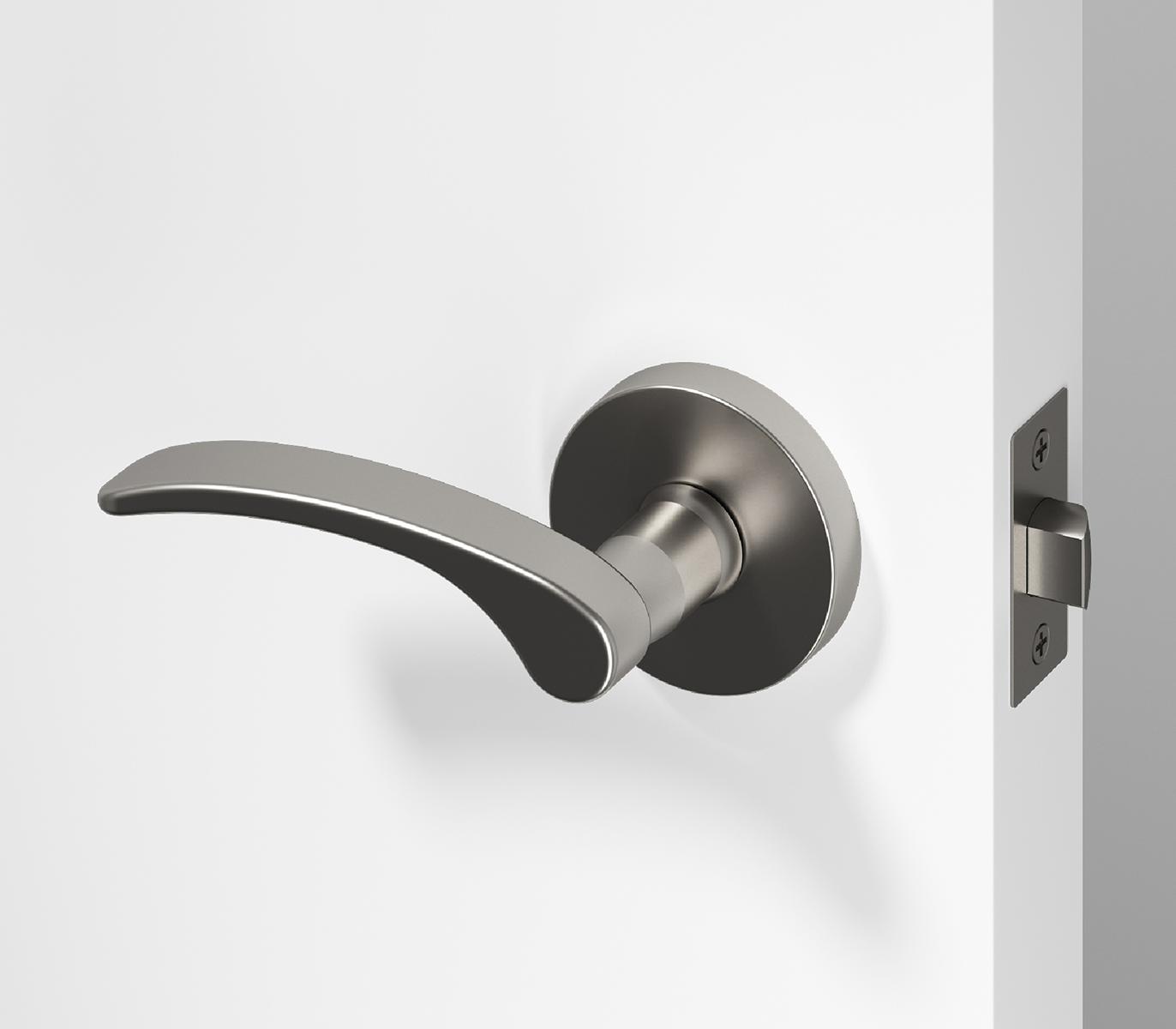
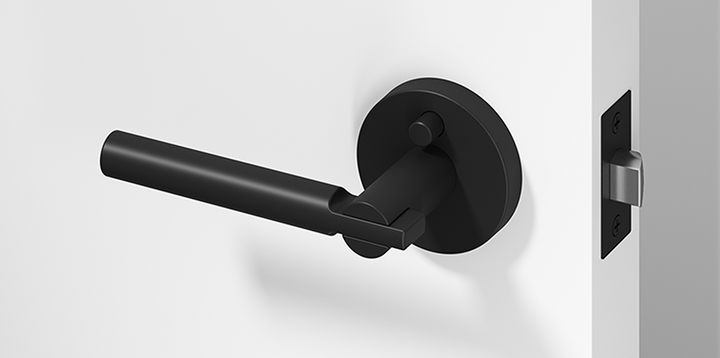
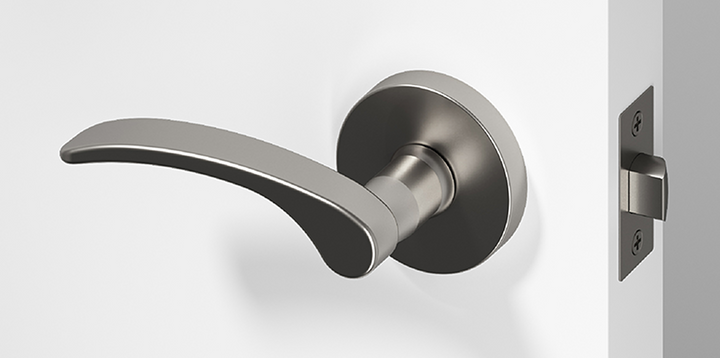
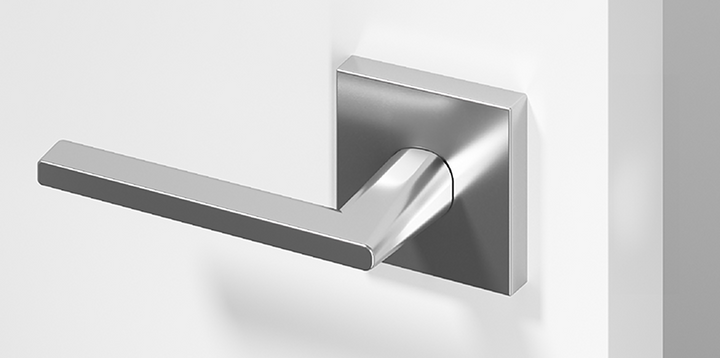
They don't — by design. PVD finishes are non-living: unlike unlacquered brass or oil-rubbed bronze, they are engineered to look the same in year fifteen as on day one. Your choice between Matte Black, Brushed Nickel, Chrome, and Champagne Brushed Gold is purely aesthetic, not a durability trade-off.
That's a genuine departure from tradition. "Living finishes" develop patina — charming on a Parisian apartment door, less charming when one high-traffic handle patinas faster than the eleven around it. Because every OKUN finish shares the same PVD process, a whole-home installation stays visually cohesive across bathrooms, bedrooms, and hallways for decades — the finish on the busiest door matches the finish on the quietest one.
That consistency is the quiet argument for finish cohesion: choose one finish, run it across every collection and function in the house, and the whole installation ages in lockstep — which is to say, not visibly at all.
Frequently Asked Questions
Quick answers on OKUN durability, cleaning, and care.
How long do OKUN door handles last?+
Decades of daily residential use. OKUN handles are solid 304 stainless steel and brass with no hollow core, finished in PVD rated at 9H hardness and backed by a lifetime finish warranty against tarnishing, flaking, and corrosion under normal residential use.
How do I clean OKUN door handles?+
A soft microfiber cloth with warm water — add a drop of mild dish soap for fingerprints — then dry. No polish, wax, or metal cleaner is needed on a PVD finish, in any of the four finishes.
What should I never use on a PVD finish?+
Abrasive pads, scouring powder, steel wool, bleach, ammonia, acetone, and aggressive metal polishes. These can scratch or chemically dull the coating — and damage from improper cleaners falls outside the normal-use warranty.
Are OKUN handles suitable for bathrooms?+
Yes. The non-porous PVD coating resists steam and humidity that degrade electroplated finishes, and the 304 stainless core resists corrosion. Choose the Privacy function for bathrooms — it includes the push-button lock and emergency release.
My lever feels slightly loose — is something wrong?+
Almost certainly not. A loose lever is a mounting or set screw that has backed off with use — normal on any door handle. Snug it with the included Allen wrench and add a twice-yearly one-minute screw check to your routine.
Do the finishes fade or patina over time?+
No. PVD finishes are non-living — they're engineered not to fade, bronze, or patina. Matte Black, Brushed Nickel, Chrome, and Champagne Brushed Gold all keep their day-one appearance, which keeps a whole-home installation cohesive for decades.
Hardware you'll install once
Solid metal. Lifetime-warranted PVD finish. Everything in the box, including the wrench you'll use twice a year. Choose your collection and finish — then forget about it for a decade or three.
Shop Door HandlesOKUN
the little details make a big difference
Designed in NYC