

OKUN · For the Trade
Door Hardware Specification Guide for Architects & Interior Designers
Door prep call-outs, finish schedules, dimension sheets, samples, and handing notes — a working reference for the person who writes the spec before a contractor ever opens it.
Why should a design professional consider OKUN?
Because the spec-relevant fundamentals — solid metal construction, PVD finishing, concealed-mount rosettes, disciplined finish range — match the architectural brands designers already trust, while the per-opening cost ($29.99–$75) makes whole-project cohesion realistic on budgets where Baldwin or Emtek would force compromises.
Most interior hardware decisions die in value engineering. The designer specs an architectural lever; the budget meets it; twenty doors later, the client is looking at builder-grade with exposed rosette screws. OKUN's position is simple: the details that matter to a trained eye — the concealed mount with no visible fasteners on the finished face, the weight of a solid lever, a finish that reads consistently door to door — at a price that survives the VE round.
This guide isn't a brand comparison (we've written that separately). It's the working reference for actually specifying the product: prep, schedules, documents, samples.

What door prep and dimensions go on the spec sheet?
OKUN levers fit standard US residential door prep with zero custom machining: 2 1/8" cross bore, 1" edge bore, adjustable 2 3/8" or 2 3/4" backset, and door thicknesses from 1 3/8" to 1 3/4". Handing is universal — every lever is field-reversible.
That last point deserves a sentence in your general notes. Because the levers are non-handed, the hardware schedule doesn't need LH/RH/LHR/RHR call-outs per opening, and a swing revision during CDs doesn't trigger a hardware reorder. The latch is adjustable between both standard backsets, so pre-bored doors from any major door supplier accept the hardware as delivered.
Here's a copy-ready call-out block for the spec:
Interior openings only. Exterior, keyed, and fire-rated openings require separately rated hardware and should be scheduled apart.
How do you build a finish schedule across a multi-room project?
With OKUN, the finish schedule collapses to one decision: every one of the eleven collections ships in all four finishes and all three functions, so a single finish selection governs the whole project — bedrooms, baths, hallways, and closets — with no "not available in that finish" exceptions to footnote.
The four finishes are Matte Black, Brushed Nickel, Chrome, and Champagne Brushed Gold — all PVD, all non-living, which means the finish on the most-used door still matches the least-used one a decade in. (Full durability and care detail in our durability guide.)
A typical residential hardware schedule, written the OKUN way:
| Opening | Function | Collection / Finish | Notes |
|---|---|---|---|
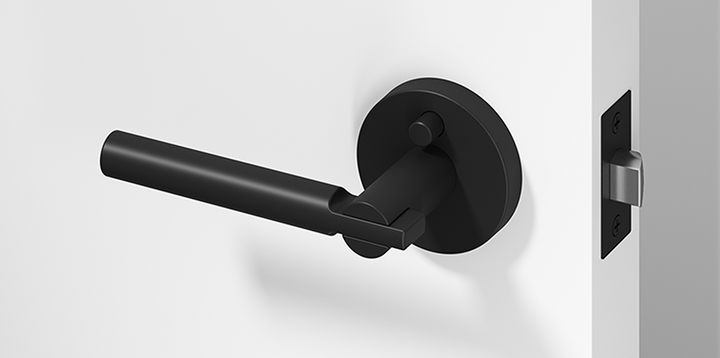
| Primary bed, beds 2–3 | Privacy | Valli · Matte Black | Push-button lock, emergency release |
| Baths (all) | Privacy | Valli · Matte Black | PVD rated for humid rooms |
| Hallway, pantry, office | Passage | Valli · Matte Black | Latching, non-locking |
| Reach-in closets | Passage | Valli · Matte Black | — |
| Double closet doors | Dummy (pair) | Valli · Matte Black | Fixed lever, surface-mounted |
| Linen, decorative | Dummy | Valli · Matte Black | — |
For projects that mix profiles — say, a statement lever on the primary suite and a quieter one elsewhere — collections can be mixed freely within one finish, since rosette diameter (2 5/8") and projection (45°) are constant across the range. The eye reads the finish and the mount; the profile becomes the room-by-room design move.


Which lever profile suits which interior?
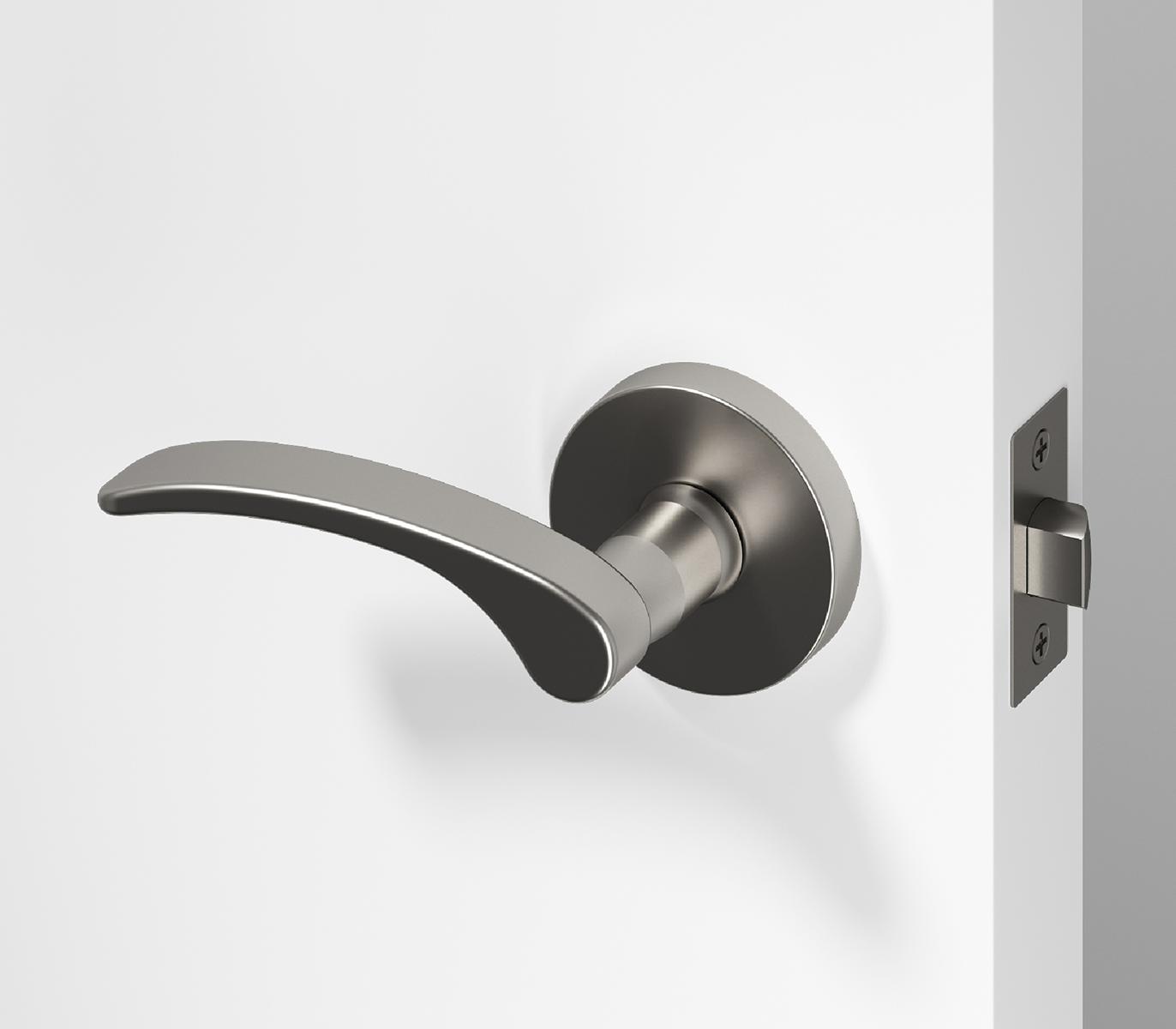
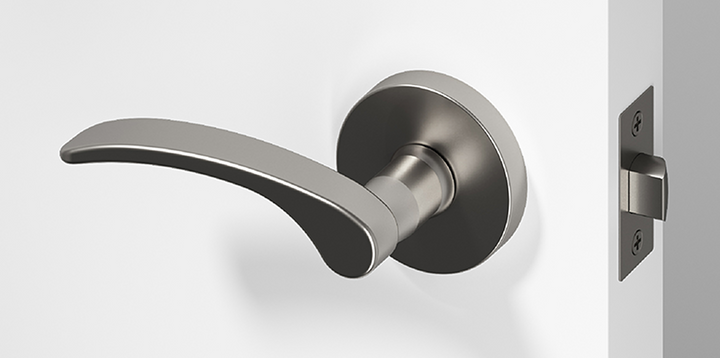
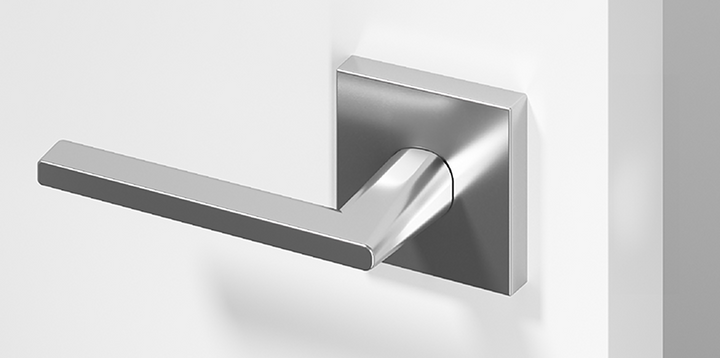
The eleven collections sort into four profile families, which is the fastest way to shortlist for a design language: slim rectangular for minimalist interiors, cylindrical for softer contemporary rooms, elongated tapered for scale and statement, and square-backplate for architectural geometry.
| Profile family | Collections | Reads best in |
|---|---|---|
| Slim rectangular | Stark, Valli, Dune, Muse | Minimalist, Scandinavian, gallery-white interiors |
| Cylindrical | Zen, Brio | Softer contemporary, Japandi, warm modern |
| Elongated tapered | Halo (5 1/4" lever) | Tall doors, larger rooms, statement openings |
| Curved contemporary | Arc | Transitional-modern, rounded architectural details |
| Square backplate | Mirra, Quadra | Rectilinear interiors, strong architectural geometry |
Lever lengths run 4 3/8" to 5 1/4" across the range. When a project's door heights vary — 8'0" doors on the main level, 6'8" upstairs — the longer Halo profile on the tall doors and a slim rectangular elsewhere keeps proportion without changing finish or rosette language.
The spec is where design intent survives or dies.
Write it so the twentieth door matches the first.
Where do you find cut sheets, dimension drawings, and submittal documents?
Every OKUN product page includes a "Documents" section with two downloadable PDFs: a dimensioned specification sheet and an installation manual for that exact model — the material a submittal package or a millwork coordination set needs.
The dimension sheets carry the measured drawings — lever length, projection, rosette diameter, bore and backset requirements — in a format that redraws cleanly into CAD details or drops straight into a submittal as-is. The installation manuals double as useful coordination documents for the GC's finish carpenter, since they show the concealed-mount sequence that differs from the exposed-screw hardware most crews default to.
For example, the Valli privacy set publishes its dimensioned spec sheet and installation manual directly on its product page — every model in the range follows the same pattern. For project-specific documentation beyond the published sheets, reach the team through the contact page.
Product SKUs follow a legible pattern — e.g. OK1009PR = Valli Privacy — which keeps a hardware schedule's product column short and unambiguous.
How do you order samples for finish approval?
Order a single dummy lever — $29.99 — in each finish under consideration. The dummy is the identical lever, finish, and rosette as the working hardware without the latch mechanism, which makes it the least expensive way to put a real PVD finish in a client's hand and against the actual paint, tile, and cabinetry on site.
Finish decisions made from a screen fail in daylight. Champagne Brushed Gold in particular has a neutral-warm undertone that photographs warmer than it reads in a north-lit room; Matte Black shifts with sheen levels around it. A finish approved from physical samples on site doesn't get re-litigated at punch.
Practical sample workflow:
| Stage | What to order | Why |
|---|---|---|
| Finish shortlist | 1× Dummy per candidate finish ($29.99 ea.) | True lever + finish + rosette, lowest cost per finish |
| Function check | 1× Privacy set in selected finish | Evaluate lock action, latch feel, emergency release |
| Client presentation | Selected profile in 2 finishes | Binary choices approve faster than open ones |
| Procurement | 1-, 2-, or 6-packs per schedule | 6-packs suit multi-door and multi-unit counts |
Standard returns & exchanges apply, so unselected finish samples aren't a sunk cost.
Does the construction hold up to what designers usually specify?
Yes — the checklist a specifier runs on architectural hardware is fully answered: solid 304 stainless steel and brass with no hollow core, PVD finish at 9H hardness with a lifetime warranty against tarnishing, flaking, and corrosion, and a concealed-mount rosette with no exposed fasteners on the finished face.
Those three attributes — solid core, PVD, concealed mount — are precisely what separates the hardware designers reach for by habit from the builder-grade tier, and they're standard across every OKUN collection rather than reserved for a premium line. The practical consequence for a specifier: there is no "good/better/best" internal tiering to navigate. Every SKU on the schedule carries the same construction.
Approved use covers residential and non-residential interiors, and the 1-, 2-, and 6-pack structure scales from a single renovation to multi-unit and hospitality guest-room counts. For the deeper material story — why PVD outlasts electroplating, humidity performance, maintenance handoff for the client's care manual — see the durability & care guide.

What goes in the closeout package?
Three things: the product dimension sheets, the installation manuals, and a one-line care note — "clean with a soft damp cloth; no abrasives or harsh chemicals" — which is the entire maintenance requirement of a PVD finish and the condition of its lifetime warranty.
Because the finish is warranted for life against tarnishing, flaking, and corrosion under normal residential use, the owner's manual section for door hardware is mercifully short. Include the order confirmation as proof of purchase, note the twice-yearly set-screw check (the Allen wrench ships in every box), and the client's facilities binder is done.
It's a small thing. But a closeout package that anticipates year ten is the difference between a spec that was written and a spec that was thought through — and it's the kind of detail clients remember when the next project starts.
Frequently Asked Questions
Specification quick reference for design professionals.
What door prep does OKUN hardware require?+
Standard US prep: 2 1/8" cross bore, 1" edge bore, adjustable 2 3/8" / 2 3/4" backset, door thickness 1 3/8"–1 3/4". No custom machining. Pre-bored doors from any major supplier accept the hardware as delivered.
Do I need handing call-outs on the hardware schedule?+
No. Every OKUN lever is universal and field-reversible, so the schedule reads "non-handed" for all openings — and a swing revision during design development never triggers a hardware reorder.
Where do I get cut sheets for submittals?+
Each product page has a Documents section with a dimensioned specification PDF and installation manual for that model — submittal-ready, and clean to redraw into CAD details. Contact OKUN for documentation beyond the published sheets.
How do I get physical finish samples?+
Order a $29.99 dummy lever in each candidate finish — identical lever, finish, and rosette to the working hardware, without the latch. Standard returns apply to unselected samples.
Can OKUN be specified for multi-unit or hospitality interiors?+
Yes — approved use covers residential and non-residential interiors, and 6-pack quantities suit multi-door counts. Interior openings only: exterior, keyed, and fire-rated doors require separately rated hardware.
Can I mix collections within one project?+
Freely. Rosette diameter (2 5/8"), projection (45°), and all four finishes are constant across the eleven collections, so profiles can vary room to room — a Halo on the tall doors, a Valli elsewhere — without breaking finish cohesion.
Put it on the schedule
Eleven collections. Four finishes. One construction standard. Start with a $29.99 finish sample, download the dimension sheets, and write the spec that survives value engineering.
Browse Collections Contact for Trade InquiriesOKUN
the little details make a big difference
Designed in NYC