

OKUN · Hardware Guide
Lockable Door Handles: The Complete Guide to Privacy Locks for Interior Doors
Push a button, and the room is yours. How lockable door handles work, which rooms need one, what happens when a toddler locks the bathroom — and why you'll never need a key.
What exactly makes a door handle "lockable"?
A lockable door handle has a locking mechanism built into the handle itself — for interior doors, that's a push-button on the inside rosette that blocks the outside lever from turning. In hardware catalogs it's listed as a privacy function, one of the three standard interior functions alongside passage and dummy.
The terminology trips up almost everyone shopping for door hardware, so here's the full map:
| Function | Locks? | How | Where it belongs |
|---|---|---|---|
| Privacy ("lockable") | Yes — keyless | Push-button inside, pinhole release outside | Bedrooms, bathrooms, offices |
| Passage | No | Latches closed, never locks | Hallways, closets, pantries |
| Dummy | No | Fixed lever, no latch at all | Double closets, decorative doors |
| Keyed entry | Yes — keyed | Key cylinder, often with deadbolt | Exterior and entry doors only |
So when you search "door handle lockable," what you almost certainly want for inside the home is a privacy handle — the keyless kind. Keyed handles on interior doors create more problems than they solve, which we'll get to. (For the non-locking side of the family, we've covered passage handles in their own guide — this one stays with the doors that lock.)

How does a push-button lockable handle work?
Press the button on the interior rosette and the outside lever is blocked from turning — the door is locked. Turn the inside lever and the button pops back out, unlocking the door automatically. The mechanism is deliberately designed so the room locks from within in one motion, and can never stay locked behind you.
That auto-release detail is the quiet genius of the privacy function. Because opening the door from inside resets the lock, you physically cannot step out of a bathroom and leave it locked — the "locked empty room" problem that plagues turn-button and keyed interior locks simply can't happen.
On the outside face, the rosette carries a small pinhole rather than a keyway. That's the emergency release: insert the included unlock tool — or a household needle or straightened paperclip — press gently, and the lock releases. No locksmith, no removed hinges, no drama.
Anatomy of a lockable door handle
Mechanically, every lever handle is a rotation machine: turning the lever rotates the square spindle, the spindle drives the tubular latch, and the latch pulls the spring-loaded latch bolt back out of the strike plate. The privacy function adds exactly one part to this chain — a blocking element behind the interior button. Pressed, it stops the exterior half of the spindle drive from rotating; the interior lever keeps full authority, which is why one turn from inside always opens the door and resets the button.
| Part | What it does |
|---|---|
| Lever | The handle itself; rotating it is the only input the mechanism needs |
| Spindle | Square shaft through the door connecting both levers to the latch |
| Tubular latch | The mechanism in the door edge that converts lever rotation into bolt retraction |
| Latch bolt | The spring-loaded angled bolt that holds the door closed in the strike plate |
| Push-button | Blocks the exterior spindle drive when pressed — the "lock" in lockable |
| Pinhole release | Exterior override; the tool depresses the blocking element to unlock |
| Rosette | The 2 5/8" trim disc; OKUN's is concealed-mount with no visible screws |
| Strike plate | The frame-mounted plate the latch bolt seats into |
The three states of a privacy lock
Every OKUN privacy set ships with the emergency unlock tool in the box, along with the levers, adjustable latch, strike plate, mounting hardware, and Allen wrench.
Which rooms need a lockable door handle?
Bathrooms and bedrooms, without exception — that's where privacy is non-negotiable. Home offices earned their place on the list in the video-call era, and guest rooms should always give visitors a lockable door. Everywhere else in the home takes a passage or dummy handle.
| Room | Function | Why |
|---|---|---|
| Bathrooms | Privacy (lockable) | The obvious one — and PVD finishes shrug off the humidity |
| Bedrooms | Privacy (lockable) | Standard for primary, kids', and guest rooms alike |
| Home office | Privacy (lockable) | Calls, focus, and a door that means it |
| Nursery | Privacy — with the release tool handy | Lockable for later years; pinhole access for now |
| Hallways, pantry, laundry | Passage | Latches shut, never locks anyone in or out |
| Double closets, decorative | Dummy | Fixed pulls, no latch needed |
The elegant part of choosing within one hardware range: the lockable and non-lockable handles are visually identical from the hallway. An OKUN privacy Valli and a passage Valli share the same lever, rosette, and finish — the only tell is the button on the inside of the rooms that need it.
A door that locks is a promise the room keeps.
The button just makes it official.
Are lockable door handles secure?
Honest answer: a privacy lock provides privacy, not security — and that's exactly what an interior door should do. The pinhole release that lets you rescue a locked-in toddler is, by design, an override. For actual security — entry doors, exterior access — you need a keyed lockset and deadbolt, which is a different product category entirely.
This distinction matters because the failure mode of over-securing interior doors is worse than the failure mode of under-securing them. A keyed lock on a child's bedroom or a bathroom means lost keys, locked-out parents, and — in a genuine emergency — a door that resists the people trying to help. Fire safety guidance consistently favors interior doors that open easily from inside, which is precisely how a privacy handle behaves: one turn of the lever, from any locked state, and you're out.
So the right frame isn't "how much lock can I put on this door" — it's matching the mechanism to the room. Privacy where privacy is needed, free passage where it isn't, and real security hardware at the perimeter of the home where it belongs.
What if someone gets locked in — or the door locks accidentally?
Use the pinhole emergency release on the outside rosette: insert the included tool (or a paperclip), press gently, and the door unlocks in seconds. This is the scenario every parent eventually meets — a toddler triumphantly pressing the bathroom button — and the reason the release exists.
Practical habits worth adopting on day one:
Store the tool where you'll find it. The classic spot is the top of the door casing on the outside of each privacy door — invisible, always in reach. Test it once at installation. Lock the door from inside, close it, release it from outside. Thirty seconds now saves fumbling later. Know the backup. Any straightened paperclip or household needle works in the pinhole — the tool is a convenience, not a proprietary key.
And because the lock auto-releases when the inside lever turns, an "accidentally locked empty room" is close to impossible with a privacy handle — the most common lockout scenario is engineered out of the product.


Do lockable door handles need a key?
No — and for interior doors, keyless is the feature, not the compromise. A privacy handle locks with a button and releases with a lever or a pinhole tool, which means there are no keys to cut, label, hide, lose, or inherit from the previous homeowner in an unmarked envelope.
Keyed interior handles exist, and occasionally make sense — a medication cabinet room, a home inventory closet. But as everyday bedroom and bathroom hardware they age badly: keys migrate, locks get keyed-alike then not, and the fifth time someone's locked out of their own bedroom, the "security" is usually defeated with the same paperclip a privacy handle would have welcomed politely on day one.
Electronic and smart locks, meanwhile, belong to the entry-door conversation — batteries, pairing, and firmware are a lot of ceremony for a bathroom door. The push-button privacy handle has stayed the interior standard for decades because it does exactly enough, mechanically, forever.
How do you install a lockable door handle?
About 15 minutes per door, with a screwdriver as the only tool. OKUN lockable handles fit standard US door prep — 2 1/8" bore hole, adjustable 2 3/8" or 2 3/4" backset, doors 1 3/8" to 1 3/4" thick — and every lever is reversible for left- and right-hand doors, so there's no wrong-handed handle to reorder.
If you're replacing an existing handle, the new hardware drops into the same holes: remove the old set (two through-bolts and the latch screws), set the OKUN latch to your door's backset, seat the exterior and interior assemblies with the button facing into the room, and mount the concealed rosette — no visible screws on the finished face when you're done. The installation manual walks each step with diagrams.
Swapping a full floor of bedroom and bathroom handles is a single relaxed afternoon — the highest-impact hardware upgrade a home gets per hour invested.
What styles do lockable handles come in?
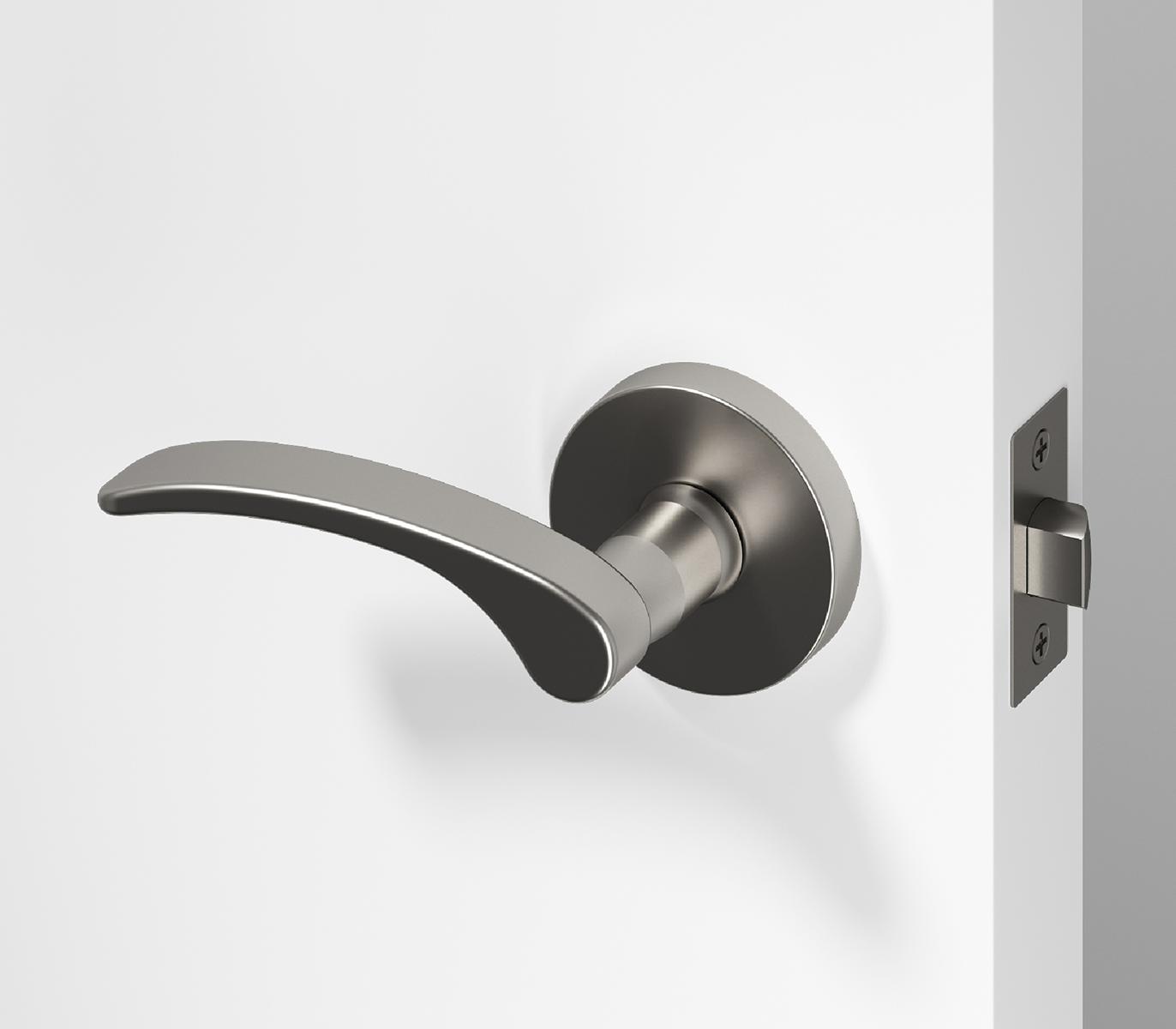
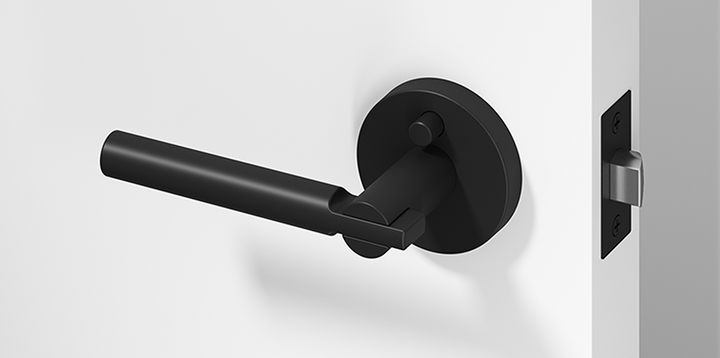
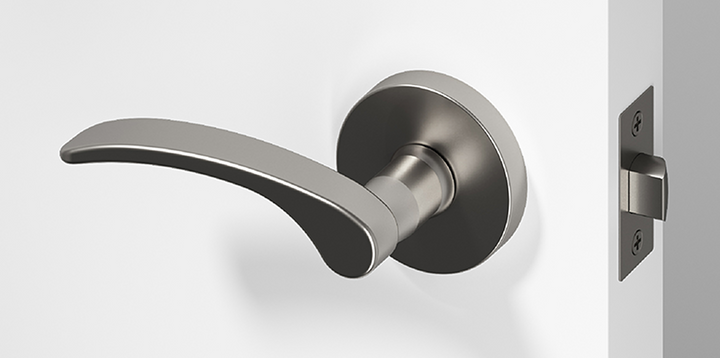
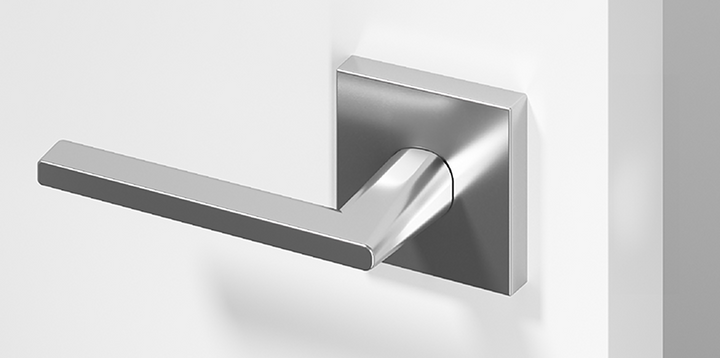
Every one of OKUN's eleven lever collections is available in the lockable privacy function — Stark, Valli, Zen, Arc, Dune, Brio, Halo, Mirra, Quadra, Muse, and Terra — each in Matte Black, Brushed Nickel, Chrome, and Champagne Brushed Gold, priced between $55 and $75 per set.
Slim rectangular profiles (Stark, Valli, Dune, Muse) suit minimalist rooms; cylindrical levers (Zen, Brio) soften contemporary spaces; the elongated Halo makes a statement on taller doors; and square-backplate designs (Mirra, Quadra) bring architectural geometry. All are solid 304 stainless steel and brass with the concealed-mount rosette and a PVD finish under lifetime warranty — the full material story is in our durability & care guide, and design professionals writing hardware schedules will find prep call-outs in the specification guide.
Because privacy, passage, and dummy functions share identical styling within each collection, the lockable doors and the non-lockable ones read as one continuous design decision — which is the entire point.
Frequently Asked Questions
Lockable door handles, answered.
What is a lockable door handle called?+
A privacy handle. In hardware catalogs, interior functions are privacy (lockable, push-button), passage (latching, non-locking), and dummy (fixed, no latch). Keyed locks are a separate category for entry doors.
Can you get locked out by a privacy handle?+
Effectively no. The button releases automatically when the inside lever turns, so the door can't stay locked behind you — and if it's ever locked from inside, the outside pinhole release opens it in seconds with the included tool or a paperclip.
Are push-button locks childproof?+
They're child-recoverable, which is better: a child can lock the door, and an adult can open it from outside in seconds via the emergency pinhole. Keep the unlock tool on top of the door casing and test it once at installation.
Should I put a keyed lock on a bedroom door?+
Generally no. Interior doors should open easily from inside in an emergency, and keyed interior locks create lockouts without adding meaningful security. Privacy handles for interior rooms; keyed locksets and deadbolts for the exterior doors.
Will a lockable handle fit my existing door?+
If your door has the standard US prep — 2 1/8" bore, 2 3/8" or 2 3/4" backset, 1 3/8"–1 3/4" thickness — an OKUN privacy handle drops straight in, and the reversible design fits both left- and right-hand doors.
How much does a lockable door handle cost?+
OKUN lockable privacy handles run $55–$75 per complete set — levers, adjustable latch, strike plate, hardware, and emergency tool included — with 2- and 6-pack options for whole-home projects. Comparable architectural brands typically run well over $100 per opening.
Lock in the details
Eleven lockable collections. Four PVD finishes. Push-button privacy with emergency release, everything in the box, fifteen minutes to install.
Shop Lockable Privacy HandlesOKUN
the little details make a big difference
Designed in NYC