

Hardware Guide
Square, Linear or Standard? How to Choose a Vent Cover Shape
Most vent covers get returned for the same small reason, and it happens before shape or finish is even on the table. Fix that first. Then we can talk about why matte white is the only sensible answer for a ceiling.

What size vent cover do I need?
Measure the hole, not the cover sitting over it. OKUN grilles are sized by duct opening, and the faceplate comes about two inches bigger in each direction so it overlaps the surrounding surface. A 12×8 opening takes a grille listed as 12×8.
Key Takeaways
- Take the old cover off before you measure. Its frame is bigger than the hole on purpose, and measuring it is how people end up two inches out.
- The shape isn't really your choice. It's decided by the opening already cut into your ceiling. You're matching, not selecting.
- Standard fits most American houses. Rectangular openings are the default, and standard grilles are sized for them.
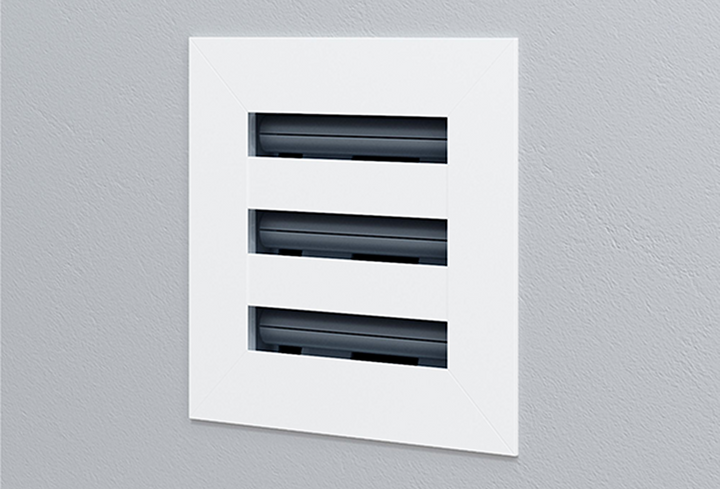
- Linear is for long narrow runs. Six sizes from 10×4 up to 30×6, and the shallow depth is what makes it read as a line.
- Square only works on a genuinely square hole. Five sizes, 6×6 through 14×14, from $35.90.
- Matte matters more than the exact white. Sheen mismatch shows on a ceiling; a shade or two of colour difference doesn't.
The mistake that happens before you pick anything
Here's how this usually goes wrong, and it happens well before shape enters the conversation.
Someone decides to replace a tired register. They walk over, put a tape across the thing screwed to the wall, get 14 by 10, and order a 14 by 10. It arrives, they hold it up, and it's swimming. A good two inches oversized in both directions, hanging past the hole like a picture frame.
Nobody did anything unreasonable. It's just that vent covers are always built larger than the opening they cover, because they have to overlap the drywall to sit flat and hide the cut edge. So the number on the box refers to the duct opening rather than the faceplate. Measure the faceplate, order that number, and you've asked for a cover sized to fit a hole two inches bigger than the one you own.
Measure the hole. Everything else on this page is downstream of that.
How to measure it properly
Three minutes, a tape and a screwdriver.
- Take the old cover off. Two screws, usually. Now you can see what you're actually dealing with.
- Measure the cut hole. Width first, then height. That pair of numbers is your size.
- Watch for paint and shims. If a previous owner painted the register in place or packed it out to sit level, the visible edge might not be the real cutout. Scrape back and measure the substrate.
- Order to the opening. Don't add the overlap. It's already in there.
Worth doing every opening in the house while you've got the tape out. Houses are rarely as consistent as you'd hope, and finding out mid-project that the hallway is a different size than the two bedrooms is a mildly demoralising way to spend a Saturday.
Now the shape — which is less of a decision than you'd think
This is where people expect to be choosing, and mostly they aren't. The hole in your ceiling has a proportion already. Your job is to match it.

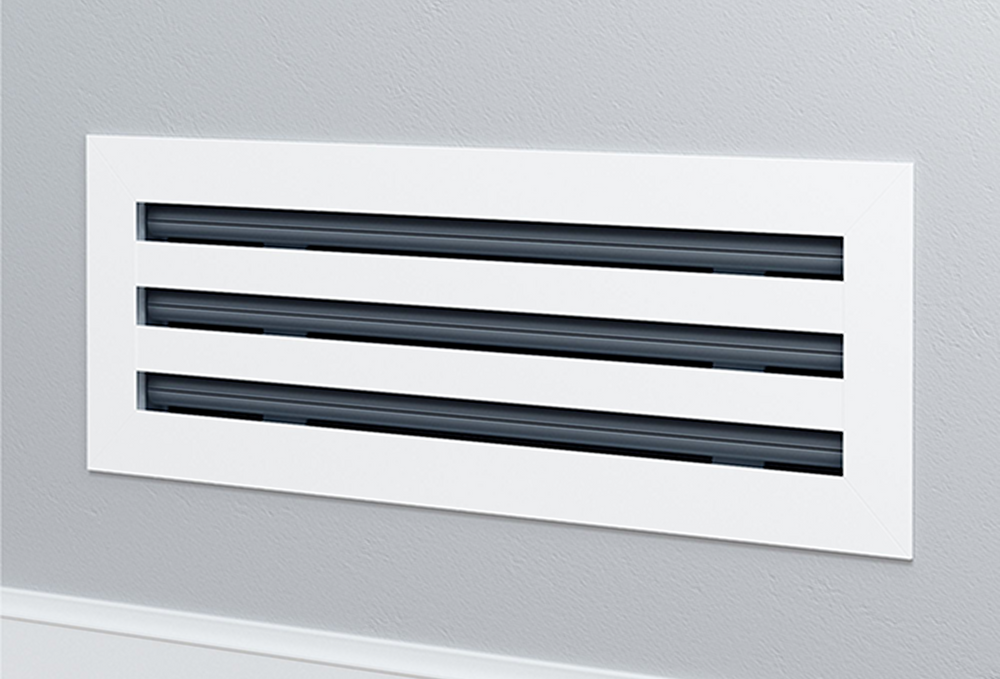

| Shape | Your opening looks like | Where it usually turns up | Sizes |
|---|---|---|---|
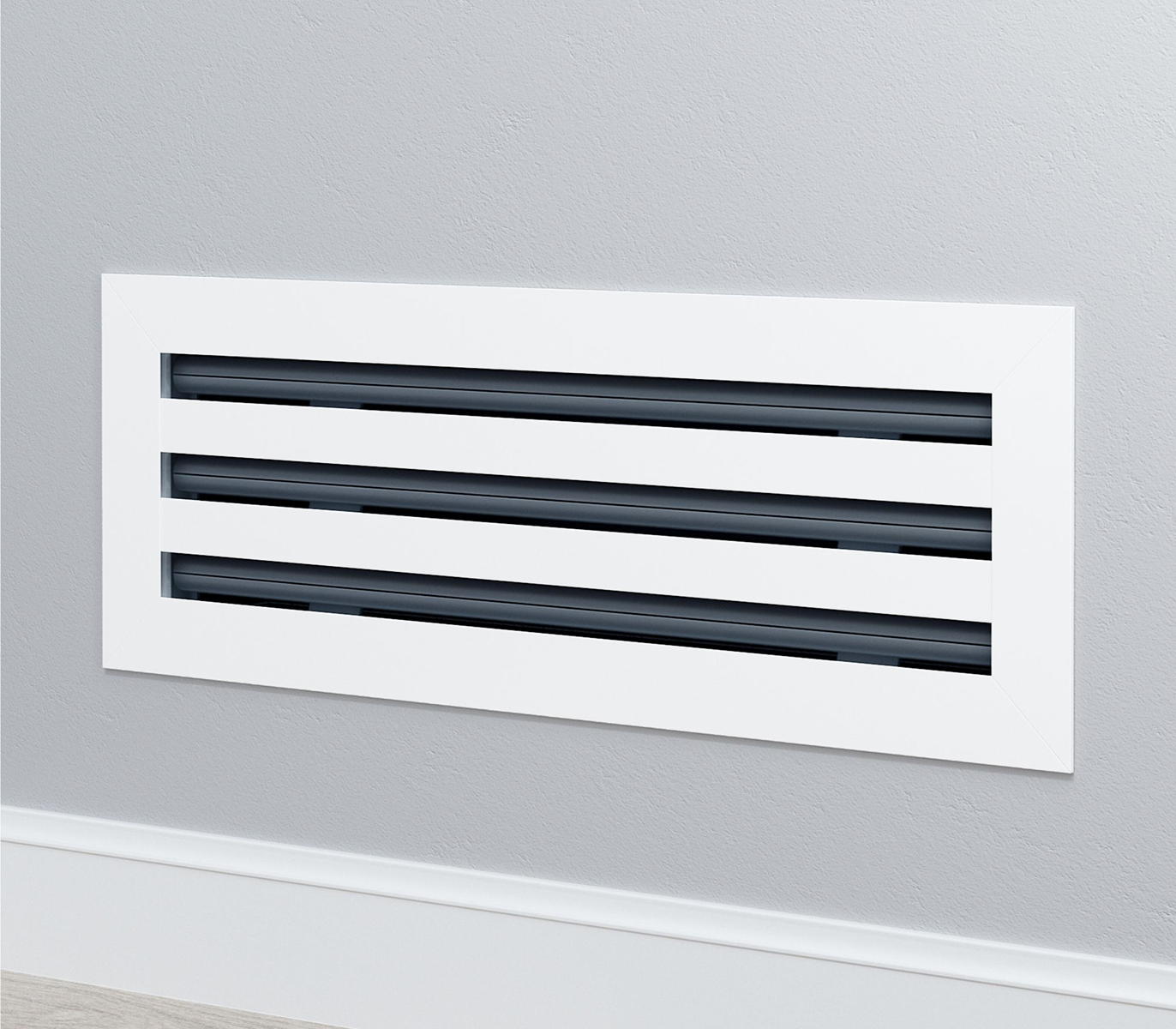
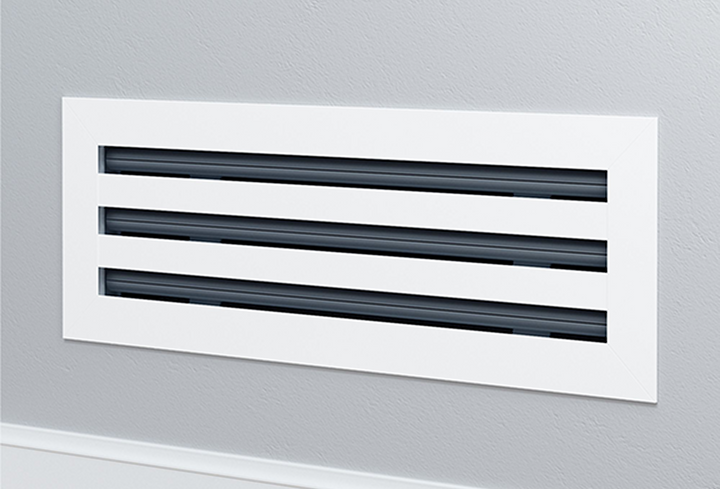
| Standard | Rectangular, noticeably wider than it is tall | The default in most American homes — walls, ceilings, hallways, bedrooms | Sized to common residential duct openings |
| Linear | Long and shallow, only 4" or 6" deep | Extended runs, above windows, along a ceiling edge where you want the line read as deliberate | 10×4, 12×4, 14×4, 16×4, 20×6, 30×6 |
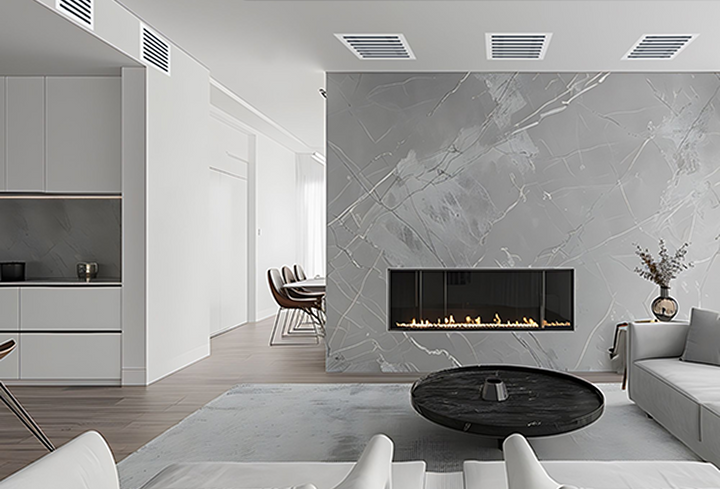
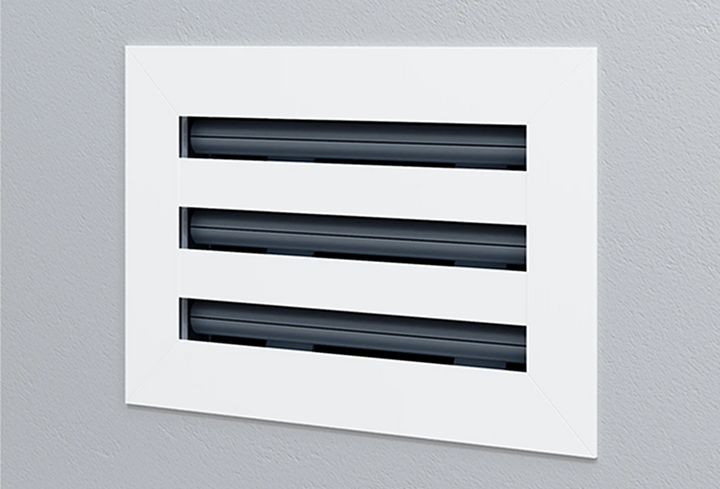
| Square | Roughly equal on both sides | Usually centred in a ceiling, occasionally on a wall in a squarer room | 6×6 to 14×14, from $35.90 |
All three lines share the same aluminium build, matte white finish and concealed mounting. The difference is proportion rather than construction, which our complete guide to architectural grilles goes into properly.
When shape genuinely is a choice
There is one situation where you get to decide, and it's during construction or a renovation deep enough that the ceiling is already open.
At that point the duct boot and the cutout are both still on the table, and it's worth thinking a beat longer than most people do. A long linear run above a window reads very differently from a rectangle stuck near a corner — it sits with the architecture instead of interrupting it, and in an open-plan space that's often the difference between hardware you notice and hardware you don't.
Outside of that window, changing shape means cutting drywall, patching, repainting, and usually modifying the boot behind. Perfectly doable. Rarely worth doing on its own, and we'd generally tell you not to bother unless something else has already brought you up a ladder.
Ceiling or wall — and does it matter?
Less than you'd expect. The same grille works on either, so you're not buying a different product for a ceiling than for a wall.
What does change is where you point the blades. They're adjustable, and on a wall register angling them slightly changes how far the air throws into the room. On a ceiling, straight down is usually fine unless you're trying to keep a draught off a particular chair, in which case tilt them away from it and stop thinking about it.
Why matte, and why white
Two decisions, and the second one is quietly doing most of the work.
White is the obvious half. Ceilings are white, most trim is white, and a white register is the one that asks for the least attention. Fine. Nobody needs a paragraph on that.
Matte is the half people underestimate, and it's worth understanding why it reads better, because once you know you can't unsee it.
Sheen mismatch shows. Colour mismatch mostly doesn't.
Your ceiling is almost certainly painted in flat or matte emulsion. Flat paint scatters light in every direction, which is exactly why it's used up there — it hides the small undulations every ceiling has, and it gives you an even plane with no hot spots.
Drop a glossy or semi-gloss register into that plane and you've introduced the only surface in the room that produces a specular highlight. A bright spot that moves as you walk under it. Human vision is aggressively good at tracking moving highlights, which is a lovely evolutionary trait and a nuisance if the moving highlight is a vent.
So the register becomes the thing your eye finds first, every time it goes up. Not because the colour is wrong, but because the surface is behaving differently from everything around it.
A matte finish scatters light the same way the ceiling does. It joins the plane instead of interrupting it. And here's the useful consequence: once the sheen agrees, you can be a shade or two off on the actual white and nobody will ever spot it. Get the sheen wrong and a perfect colour match won't save you.
Match the sheen and you can be sloppy about the shade. It doesn't work the other way round.
The yellowing problem
The other reason we don't use plastic.
Plastic registers start out a convincing white and don't stay there. Two things work against them: ultraviolet light, and the fact that a supply vent has warm air moving through it several hours a day for years. Heat cycling plus UV is how white plastic goes cream, then faintly biscuit, and it happens slowly enough that nobody notices until a fresh one goes up next to an old one and the difference is embarrassing.
Our grilles are powder-coated aluminium with a fade-resistant matte white finish, so there's no plastic to yellow and no steel to rust. That last part matters more than it sounds in bathrooms, laundries and kitchens, where a stamped steel register will eventually bloom orange around the screw heads.
Dust, briefly
Matte white is also about the most forgiving surface you could pick for something that sits in an airstream. Dust on a dark or glossy register reads as a grey film. On matte white it reads as very slightly less white, which is to say it reads as nothing until you wipe it, and then you feel briefly smug.
Small style choices that cost nothing
Assuming you've matched the shape and the sheen, there's a short list of things that separate a room where the vents were fitted from a room where they were placed. None of them costs money. All of them get skipped.
- Run the blades the same direction everywhere. This is the big one. Louvres running left-to-right in one room and front-to-back in the next is the visual equivalent of a crooked picture, and it's completely free to get right. Pick an orientation per floor and stick to it.
- Align to the room, not to the duct. The boot behind the ceiling was positioned for convenience during framing. The cover doesn't have to inherit that logic — square it to the walls, not to whatever's above it.
- Don't try to fix a bad location with a nice cover. A register eighteen inches off centre in an otherwise symmetrical ceiling will still look eighteen inches off centre in aluminium. Either move it while the ceiling's open or accept it and move on.
- Do the whole floor at once. One new grille among five old ones makes the five old ones look considerably worse than they did yesterday. This is not a coincidence and it will bother you.
That last point is the same argument we make about door hardware, for the same reason. Anything that repeats through a house is judged as a set, not individually.
Supply or return? You don't need to know
Worth mentioning because it stops people ordering.
Every opening in a forced-air system is either pushing conditioned air into the room or pulling it back out. Supply or return. Plenty of brands sell different covers for each, which means identifying every vent before you can buy anything.
OKUN grilles are dual-function, so one line covers every opening in the house and the question never comes up. If you're curious anyway: hold a tissue near it with the system running. Blown away is supply, sucked toward is return. That's the entire test.
The bit nobody tells you
Registers are one of the very few upgrades where the cheap version and the good version take exactly the same amount of work to fit. Same screwdriver, same ten minutes, same ladder. The only variable is which box you opened.
Which is a slightly annoying thing to realise about the plastic ones already on your ceiling.
Frequently Asked Questions
Measure the duct opening — the actual hole cut into the ceiling or wall — not the cover currently sitting over it. OKUN grilles are sized by that opening, and the faceplate runs roughly two inches larger in each dimension so it overlaps the surrounding surface. A 12×8 duct opening takes a grille listed as 12×8, which arrives with a 14×10 face.
Because every register is built larger than the hole it covers, by design. Measuring the old faceplate and ordering that size gives you a grille roughly two inches too big in both directions. This is the single most common ordering error, and it is why the size on the box refers to the duct, not the cover.
Shape and proportion, nothing else. Standard grilles are rectangular and sized to common residential duct openings. Linear grilles are long narrow slot diffusers for extended runs. Square grilles are square-format for evenly proportioned openings. All three share the same concealed-mount construction, aluminium build and matte white finish.
Only if you change the hole. The shape is determined by the duct opening already cut into your ceiling or wall, so a rectangular opening takes a rectangular grille. Switching to a different shape means cutting and patching drywall and, usually, altering the duct boot behind it — a job worth doing during a renovation and rarely worth doing on its own.
Six sizes by duct opening: 10×4, 12×4, 14×4, 16×4, 20×6 and 30×6 inches. The narrow four and six inch depths are what make the run read as a line rather than a rectangle, which is the whole point of the shape.
Five sizes from 6×6 to 14×14 inches, starting at $35.90 and rising with dimension. Square works when the duct opening genuinely is square — forcing a square cover onto a rectangular opening is not something you can do without cutting.
Yes. OKUN grilles are engineered for both ceiling and wall installation, and the blades are adjustable so you can direct airflow appropriately for either. Orientation matters more than the surface — on a wall, angling blades slightly upward or downward changes how the air throws into the room.
Not with OKUN. The grilles are dual-function, serving as both supply and return, which means one product line covers every opening in the house and you do not have to identify which is which before ordering. If air blows out, it is supply; if a tissue held nearby gets pulled toward it, it is return.
Closely enough, and the reason is sheen rather than colour. Ceilings are usually painted flat or matte, and a matte register scatters light the same way that paint does, so it joins the plane instead of standing out. Once the sheen agrees, a shade or two of difference in the white itself is effectively invisible. A gloss register in a matte ceiling looks wrong even when the colour is an exact match.
Plastic ones do. Ultraviolet light and years of warm supply air passing through cause white plastic registers to shift toward cream and then a faint biscuit tone, usually so gradually that nobody notices until a new one is fitted alongside. OKUN grilles are powder-coated aluminium with a fade-resistant matte white finish, so there is no plastic to yellow and no steel to rust.
You should not need to, and we would suggest not. The powder coat is a factory-cured finish that is harder and more even than anything achievable with a brush or a rattle can, and paint applied over adjustable louvres tends to bridge the gaps and stiffen the blades. If a ceiling colour genuinely demands it, spray a test piece first and keep it off the moving parts.
Less than on almost any alternative. Dust sitting on a dark or glossy register reads as a grey film, while on matte white it reads as marginally less white, which in practice means it goes unnoticed between cleans. A dry cloth or a vacuum brush attachment restores it.
Approximately 1.8 inches, within about a tenth of an inch. Worth checking against your duct boot if the opening is shallow or if a previous cover sat unusually flush, though the vast majority of standard residential installations have room.
Usually not, and it does not matter. OKUN grilles use concealed mounting rather than screws through the visible face, so fixing points differ from a builder-grade register anyway. Installation is a screwdriver job and the faceplate overlap covers the old holes.
Keep Reading
- Architectural Grilles: The Complete Guide — what makes a grille architectural, and how the line is built
- Square Vent Covers, Compared — how the square line stacks up on price and looks
- Durability & Care — finishes, wear, and a thirty-second cleaning routine
Measure the hole. We'll do the rest.
Standard, linear and square — aluminium, matte white, concealed mounting, free 3–5 day delivery.
OkunThe little details make a big difference. © 2026 OKUN.