

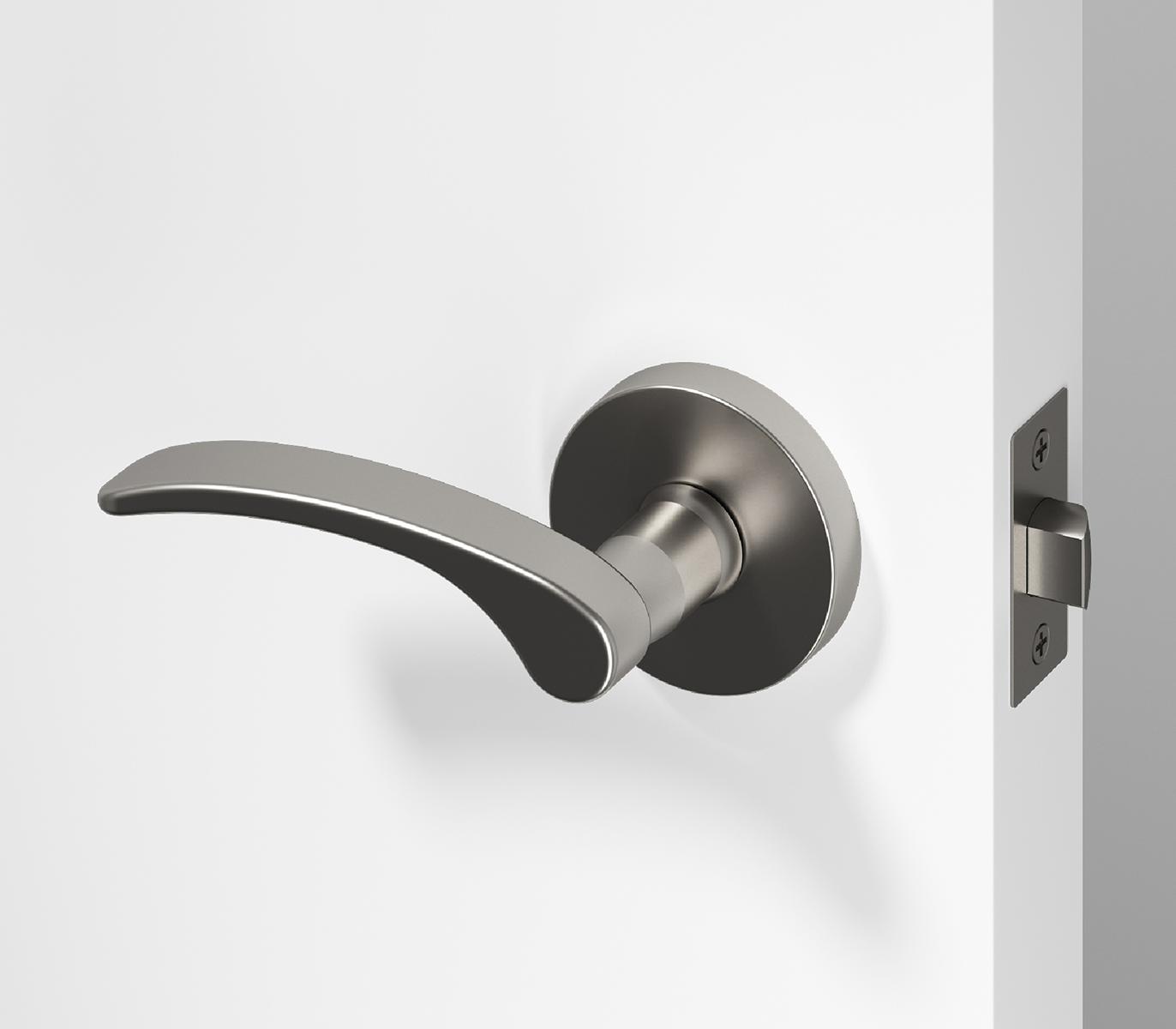
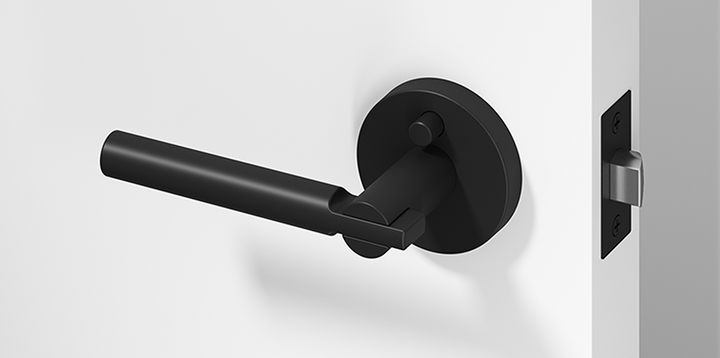
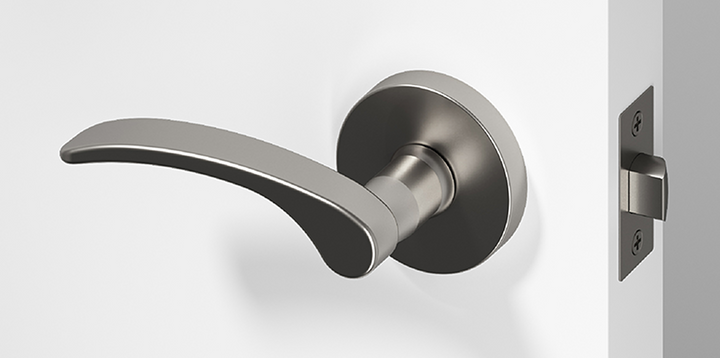
A lever sticks out 2 5/8" from the door. Here's how to check every door in two minutes, and what to fit when one doesn't clear.
Quick Answer
Will a lever door handle hit my wall?
It will if the door can swing that far. An OKUN lever projects 2 5/8" from the face of the door. When a door opens toward a wall, a vanity, a light switch or another door, the lever gets there first. A door stop that holds the door about 3" off the wall at handle height solves it.
Checking takes two minutes and a tape measure. How to do it, and which stop to fit, is below.

Most people learn about clearance the same way: a dent in the drywall, exactly the shape of a lever.
It's an easy problem to avoid and a cheap one to fix. You just have to check before the first slam, not after.
Key Takeaways
How far does a door lever stick out?
Every OKUN lever projects 2 5/8" from the door surface. That's the space the handle needs between the door and whatever the door swings toward. The rest of the spec sheet explains where it lands.
| Spec | OKUN | What it means for clearance |
|---|---|---|
| Projection | 2 5/8" | The space needed between door and wall |
| Lever length | 4 5/8" | How wide a strip of wall the lever can reach |
| Rosette | 2 5/8", round or square | Sits flatter than the lever and never touches first |
| Backset | 2 3/8" or 2 3/4" | How far in from the door edge the handle sits |
| Handle height | About 36" | The height to check for switches, towel bars and counters |

The rosette never touches first. The tip of the lever always does.
The two-minute check
Do it on every door before you order. You need a tape measure and nothing else.
- Open the door all the way. Open it slowly and note what it reaches first: the wall, an existing stop, a cabinet, another door.
- Find handle height. About 36" from the floor, roughly where the current handle sits.
- Measure the gap. Measure from the face of the door to whatever it's resting against. 3" or more and you're clear. Less, or touching, and the door needs a stop, or a longer one.
- Look up and around. Check for light switches, thermostats, towel bars and shelf edges in the lever's path. They're the ones people miss.
Replacing knobs? A knob hits the wall dead center. A lever is an arm, so it lands a few inches toward the hinge. The old dent, and the round protector that covered it, will be in the wrong place. Plan on a stop, not a new bumper.

Five places levers get into trouble
01 · Bedrooms & hallways
The door that swings flat to the wall
The classic bedroom and hallway door. With no stop, the lever reaches the drywall before the door does, and every hard push leaves a mark.
02 · Corners
Two doors in one corner
A bathroom door and a closet door opening into the same corner can meet lever to lever. That's metal on metal, and the finish loses. Open both at once and see where they meet.
03 · Bathrooms
Doors near a vanity, towel bar or toilet
Bathrooms are tight, and often there's no clear stretch of baseboard where you need it. The lever finds a countertop edge, a towel bar or a tank lid instead. If a towel bar sits right at lever height, moving it a few inches is sometimes the cleanest answer.
04 · Switches
Light switches and thermostats behind the door
Switches sometimes end up on the wall the door swings toward. A lever at speed can crack a switch plate or knock a thermostat off its base.
05 · Closets & pantries
Shelving close to the swing
Shelf edges and wire racks often sit right where the door opens. A lever that catches a shelf lip gets scuffed every time.

Which door stop to fit with a lever handle
There are four main types. Most homes end up using two or three.
| Type | Best for | Watch for |
|---|---|---|
| Baseboard | Most bedroom and hallway doors that open toward a wall | Choose a length that leaves about 3" at handle height |
| Hinge-pin | Bathrooms, and anywhere without usable wall or baseboard | Must suit your hinge. On heavy solid-core doors, many installers prefer baseboard or floor |
| Floor | Doors opening into open floor or toward cabinets | Very solid. Keep it out of walking paths |
| Wall bumper | A backup where the lever lands | Use a flat one, not a concave knob catcher, placed where the lever lands |
Stop types summarized from Direct Door Hardware; clearance figures from OKUN product specifications. Sources at the end of the article.
Where you put the stop matters as much as which one. The closer it sits to the hinge, the more leverage the door has on the hinge screws every time someone pushes it.
Stop near the handle, not the hinge. The door stops gently and the hinges stay tight.
Is a lever easier on your knuckles than a knob?
Usually, yes. With a knob, your whole hand wraps around a ball right beside the door edge, and in a tight frame the knuckles scrape. A lever puts the grip 2 5/8" off the door and out along the arm, away from the frame. The bigger question is covered in Door Knob vs Lever Handle.
Does a round or square rosette need more room?
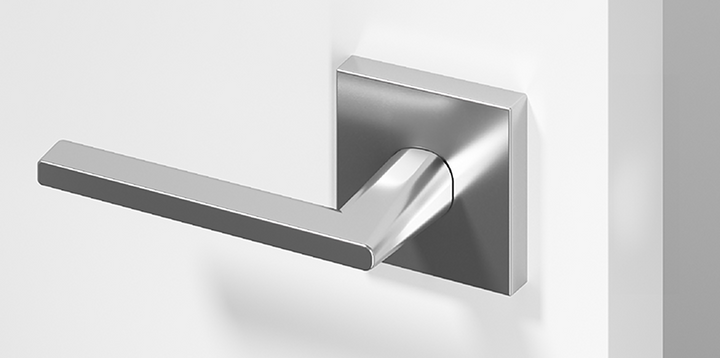
No. OKUN's round and square rosettes are both 2 5/8", and both sit flatter than the lever. In every tight spot above, the tip of the lever touches first. Choose the shape for how it looks on your door.
 StarkRound rosette · 2 5/8"Passage $49.99 · privacy $59.99
  QuadraSquare rosette · 2 5/8"Passage $49.99 · privacy $59.99
What OKUN makes
Twelve lever collections, from Stark to Quadra, in matte black, brushed nickel, chrome and brushed champagne gold. Every one projects the same 2 5/8", so a stop sized for one OKUN lever works for all of them.
Every one is solid brass, reversible for left- and right-hand doors, and has an adjustable 2 3/8" or 2 3/4" backset and a concealed-mount rosette. Privacy $59.99, passage $49.99, dummy $29.99. Fitting one takes about 15 minutes.
Premium Door Handles for Less
Measured, stopped, sorted.
Twelve collections in four finishes. Round or square rosettes, concealed screws, reversible and adjustable, from $29.99, with free 3–5 day delivery.
Frequently asked questions
Will a lever door handle damage my wall?
Yes, if nothing stops the door first. OKUN levers project 2 5/8" from the door, so a door that swings fully open presses the lever into the drywall. A stop that holds the door about 3" off the wall prevents it.
Do I need a door stop on every door?
Only on doors that can swing far enough to touch something: a wall, a cabinet, a switch or another door. Open each one fully and measure at handle height. Under 3" means it needs a stop.
How far should a door stop hold the door from the wall?
About 3" at handle height for a lever that projects 2 5/8". That leaves margin for a hard push or a spring stop that flexes.
Can I reuse the wall protector from my old door knob?
Usually not. A knob hits dead center, but a lever lands a few inches toward the hinge, along its arm. Concave knob protectors also don't suit the end of a lever. Fit a stop, or a flat bumper where the lever actually lands.
Are hinge-pin door stops any good?
They're the neat answer where there's no wall or baseboard, as in many bathrooms. They must suit your hinge, and on heavy solid-core doors many installers prefer a baseboard or floor stop to keep strain off the hinge.
Does a square rosette need more clearance than a round one?
No. Both OKUN rosettes are 2 5/8" and sit flatter than the lever. The lever tip is always what touches first.
Will an OKUN lever fit my existing door?
OKUN handles fit standard bored interior doors 1 3/8" to 1 3/4" thick, with an adjustable 2 3/8" or 2 3/4" backset. See how to measure yours.
Keep Reading
- Will This Door Handle Fit My Door? — backset, thickness and handing
- How to Install a Door Handle in 15 Minutes — one screwdriver
- Passage vs Privacy vs Dummy — which function goes on which door
- Dummy Closet Door Handles — how many you need
Sources: OKUN — Stark Passage specifications · OKUN — Quadra Passage specifications · OKUN — Will This Door Handle Fit My Door? · Direct Door Hardware — Types of door stops
OkunThe little details make a big difference. Designed in NYC.