

OKUN Editorial · Buying Guide
Will This Door Handle Fit My Door? How to Measure Before You Buy
Three measurements decide whether a handle fits: backset, door thickness, and handing. Take all three in about five minutes — then order with no guesswork and no wrong-fit returns.
A door handle fits if three things line up: the backset (2-3/8" or 2-3/4"), the door thickness (1-3/8" to 1-3/4"), and the handing (left, right, or reversible). OKUN levers use an adjustable latch that covers both standard backsets, fit standard door thicknesses, and are fully reversible — so they fit the large majority of interior doors with no re-drilling.
A broken or dated handle makes every product page feel urgent — and then the listing asks for "backset" and "bore" and "door thickness," and the urgency turns into doubt. The good news: fit comes down to three numbers, every one of which you can measure with a tape measure in a couple of minutes. Get them first. Finish, shape, and color all come after the fit is confirmed.

Backset — the one that trips people up
The backset is the distance from the edge of the door to the center of the large hole bored through the door face (where the lever mounts). It's the number listings mean when they say "2-3/8" or "2-3/4"." In the US, residential doors use one of those two — almost nothing else.
How to measure it
Hold a tape measure flat against the face of the door. Start at the door's edge and measure straight across to the center of the bore hole. Don't angle the tape up, and don't wrap it around the edge. The number will land at 2-3/8" or 2-3/4".
Don't know which you have? That's the point of an adjustable latch. OKUN's latch sets to both 2-3/8" and 2-3/4", so you don't have to measure perfectly or guess right — it adjusts to your door either way.
Door thickness — measure the slab, not the frame
Thickness decides whether the two levers can connect through the door. Measure straight through the door slab itself — not the frame, not the trim. Standard interior doors run 1-3/8" to 1-3/4" thick. Older homes sometimes have thinner doors; custom builds can be thicker.
Handing — and why a reversible handle makes it a non-issue
Handing describes which way a door swings. To check it, stand on the outside of the room and face the door: if the hinges are on the left, it's a left-handed door; on the right, right-handed. Handing only matters when a handle is directional and can't be flipped.
This is where reversible hardware quietly saves you. Because every OKUN lever installs on a left- or right-hand door, you never have to get handing right before ordering — the same handle works on any door in the house.
The OKUN fit specs, in one place
If your door falls inside these ranges — and the overwhelming majority of US interior doors do — an OKUN lever fits.
| Spec | OKUN range | Standard door? |
|---|---|---|
| Backset | 2-3/8" or 2-3/4" (adjustable) | Yes — both US standards |
| Door thickness | 1-3/8" to 1-3/4" | Yes — standard interior |
| Bore hole | 2-1/8" (standard) | Yes — drops into existing |
| Handing | Reversible (left or right) | Any door |
| Rosette | 2-5/8" round backplate | Covers standard prep |
Replacing an old handle: will it cover the existing holes?
This is the question that stops most replacement purchases — and for a standard swap, the answer is reassuring. If you're replacing an existing interior handle, your door is already bored to the standard 2-1/8" hole at a standard backset. A standard replacement drops straight in. OKUN's 2-5/8" round rosette sits over that prep and covers it cleanly, so there are no exposed gaps to fill.
The cases where holes don't line up are specific: switching between very different hardware types (an old rectangular-prep handleset, or a mortise lock), or moving the handle to a brand-new position. For a like-for-like interior lever or knob swap on a standard door, the new rosette covers the old footprint.
Switching from a knob to a lever (or the reverse)
You can absolutely replace a door knob with a lever — it's one of the most common upgrades, usually done for the cleaner look and easier grip. Because both use the same standard 2-1/8" bore and standard backset, a lever installs into the same hole a knob came out of. No new drilling, no patching, as long as the door is standard-prepped. The reverse works too.

Does it depend on the type of door?
The three measurements above cover the vast majority of interior doors, but a few door types come up often enough to address directly.
Hollow-core vs. solid doors
An OKUN lever installs the same way on both. The difference is only in how the mounting screws bite: a solid door grips anywhere, while a standard-prepped hollow-core door has a solid block at the bore for exactly this reason. Both hold a standard lever securely with the included screws.
Bedroom, bathroom, hallway, and closet doors
These are all standard interior doors, so the fit specs are identical — you choose the function (privacy for bed and bath, passage for hallways and closets) rather than a different size. For the full breakdown of which function goes where, see our passage vs. privacy vs. dummy guide.
One quick spec to know: handle height
If you're installing on a new door rather than replacing, the standard handle height is about 36" from the floor to the center of the lever — the same line as most existing doors in a home. Matching that height keeps a hallway of doors visually aligned.
One more pre-buy question: what's in the box?
The other thing people check before ordering is whether they'll need a separate trip to the hardware store. With OKUN, no — every set is complete.
- Two levers (interior + exterior)
- Adjustable latch (2-3/8" / 2-3/4")
- Strike plate
- Mounting screws
- Allen wrench
- Emergency unlock tool (privacy sets)

Measured up? Pick your finish.
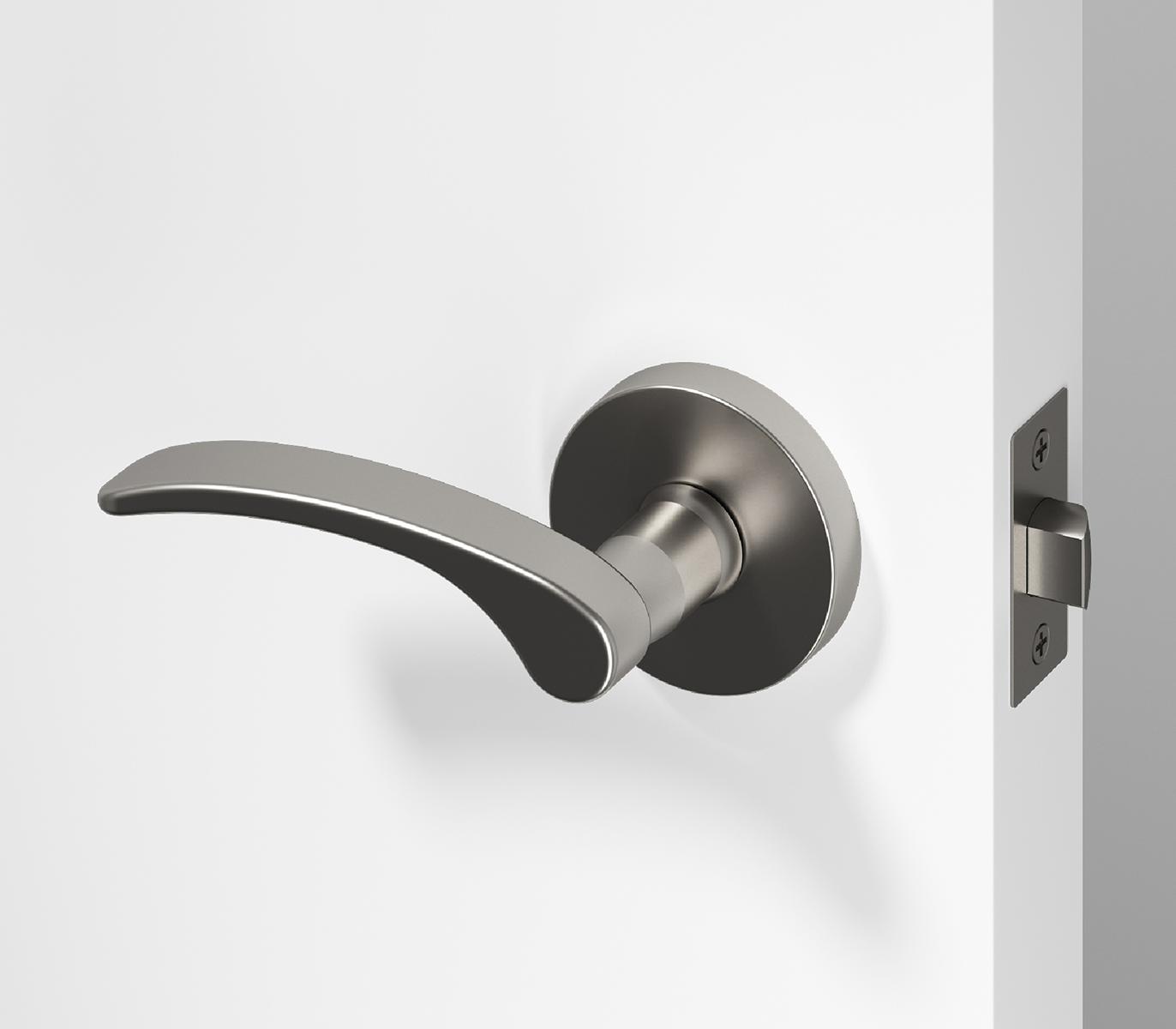
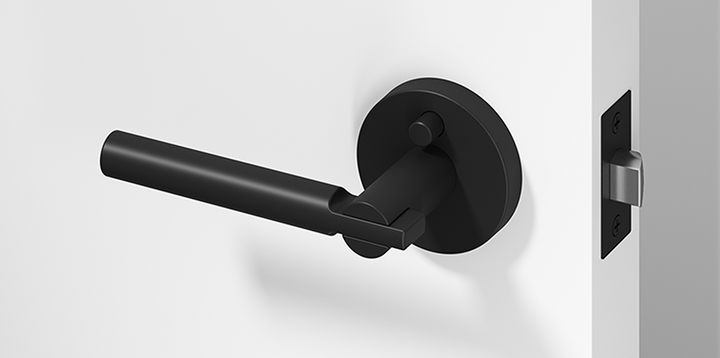
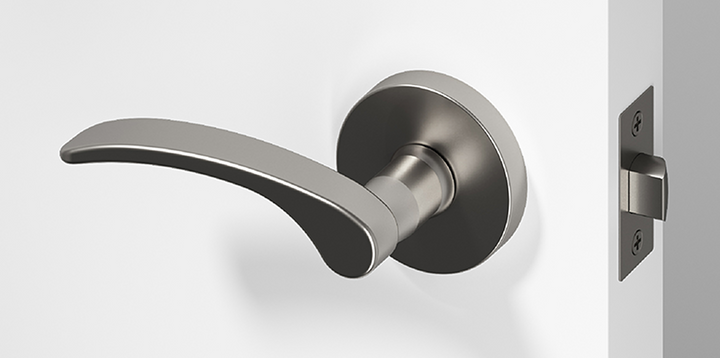
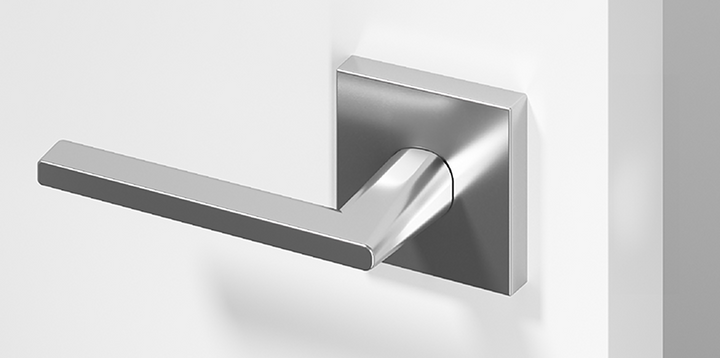
Adjustable backset, reversible, complete in the box — across matte black, brushed nickel, chrome, and champagne gold.
Shop OKUN Door HandlesCommon questions
Will any door handle fit my door?
Most fit standard doors, but three numbers decide it: backset (2-3/8" or 2-3/4"), thickness (1-3/8" to 1-3/4"), and handing. OKUN's adjustable latch covers both backsets, fits standard thicknesses, and is reversible — so it fits the large majority of interior doors with no re-drilling.
What is a backset and how do I measure it?
It's the distance from the door's edge to the center of the bore hole on the face. Hold a tape measure flat against the door, measure edge to hole-center — it'll be 2-3/8" or 2-3/4". OKUN's latch adjusts to either.
What's the difference between 2-3/8" and 2-3/4" backset?
They're the two US standard distances — 2-3/8" is the common interior size, 2-3/4" is often used on exterior or larger doors. An adjustable latch sets to both, so you don't need to know which you have before ordering.
How do I tell if my door is left- or right-handed?
Stand outside the room facing the door and look at the hinges — left hinges mean left-handed, right hinges mean right-handed. With a reversible handle it doesn't matter, because it installs on either.
Are door handles universal?
Not entirely — interior and exterior differ, and handles vary by backset, thickness, and handing. But a handle that covers both backsets, fits standard thickness, and is reversible fits nearly any interior door. OKUN levers are built to that standard.
Will I need to drill new holes?
Usually not. If you're replacing an existing handle, the door is already bored to standard, so a standard handle drops in. OKUN uses the 2-1/8" bore and adjustable backset, so most replacements need no new drilling.
Do I need to buy the latch separately?
No. The adjustable latch, strike plate, screws, Allen wrench, and (on privacy sets) the emergency unlock tool are all in the box. Nothing extra to buy.
Will a new handle cover my old holes?
For a standard like-for-like swap, yes. Your door is already bored to the standard 2-1/8" hole, and OKUN's 2-5/8" rosette sits over that prep and covers it. Holes only mismatch when switching between very different hardware types or moving the handle's position.
Can I replace a door knob with a lever?
Yes — it's a common upgrade for easier grip and a cleaner look. Both use the same standard 2-1/8" bore and backset, so a lever drops into the hole a knob came out of, with no new drilling on a standard door. The reverse works too.
What if the screw holes don't line up?
On a standard interior replacement they will, because the bore and backset are standardized. Misalignment usually means the old hardware was a non-standard type (like a rectangular-prep handleset or mortise lock), or the handle is being moved to a new spot — not a like-for-like lever swap.
Does it work on a hollow-core door?
Yes. A standard-prepped hollow-core door has a solid block at the bore, so the included screws grip securely — the lever installs the same as on a solid door.
How high should a door handle be?
The standard is about 36" from the floor to the center of the lever, which matches most existing interior doors. If you're replacing rather than installing new, the height is already set by the existing bore.