

Door Hardware Guides
Veneer Doors and Door Hardware: What to Do Before You Drill
Most slabs ship unbored, and the face is two hundredths of an inch thick.
Quick answer
Most veneer interior doors are hollow-core, and the handle can only go where there is a lock block — a solid section built into the stile. US slabs mostly ship unbored, so finding it is your job, not the factory's.
Veneer doors are the most common interior door in American homes. They are also the easiest to ruin during a hardware swap.
Not because the hardware is wrong. Because the face is two hundredths of an inch thick and there is a specific place inside the door where a handle is supposed to go.
★ Key Takeaways
-
Read the top edge first. JELD-WEN stamps
<LBorLB>there — the arrow points to the lock block. - Some US doors have two blocks, some have one. Do not assume either.
- Most slabs on the shelf are unbored. At Home Depot, hollow-core slabs run about four to one unbored against pre-bored.
- Bore from both sides. Stop when the pilot bit breaks through, then finish from the other face.
- Stile width decides your backset. A narrow stile will not take a 2 3/4" backset — which is why an adjustable latch matters.
What a veneer door actually is
A veneer door is not solid wood. It is a sandwich.
The trade calls it a five-layer sandwich. A thin slice of real wood, glued to fiberboard, bonded to each side of a structural core.
The wood you can see is thinner than most people picture. US architectural specifications call for a face veneer of 1/50 of an inch after factory sanding — 0.020", about half a millimeter.
A credit card is three times thicker than the wood on the face of your door.
Underneath is either a hollow core or solid particleboard. Doormerica specifies its hollow core as a cellular honeycomb with 5" hexagonal cells.
Both are sold with veneer faces. Most residential ones are hollow.
The frame around that core is slim. Doormerica publishes stiles at 1" nominal, 13/16" minimum after prefit.
That is the timber your handle has to live in. It is why the lock block exists at all.
The lock block, and how to find it
A hollow-core door cannot hold a handle in a void. So manufacturers build in a lock block: a solid section inside the stile, at handle height, put there so a latch has something to bite.
Published US sizes vary a lot, which is worth knowing because no single figure is right.
| US manufacturer / spec | Lock block | Material |
|---|---|---|
| Steves & Sons | 3" × 7 1/2" | Particleboard |
| Doormerica, molded panel | Double 3" × 10" | Particleboard, 28 lb |
| Doormerica, flush hollow core | Double 3" × 20" | Particleboard, 28 lb |
| Oshkosh Door, architectural | 5" × 10" minimum | — |
| NYC HPD standard | 20" × 2 1/4" minimum | Glue bonded to face skins |
One block or two?
Both are normal in the US, which is a real difference from what you may have read.
Lynden Door states "two lock blocks in all book edge doors." Doormerica lists its blocks as "double."
New York City's housing specification goes further and requires "a one-piece solid block (on each side) to properly secure lock to the door."
Other doors have one. Assume nothing.
Read the top edge
JELD-WEN publishes the answer. It is the clearest instruction any US manufacturer gives:
"If installing a hollow core door that does not have a lock set hole, refer to the top edge of the door. There will be an inked stamp with either <LB, LB> or <LB>. The arrow next to the LB indicates the lock block location."
So the notation reads like this:
-
<LB— block on the left edge as you face that side -
LB>— block on the right edge -
<LB, LB>— blocked on both edges
That stamp is also the reason to never trim the top of a door. It is the only label telling you where the handle can go, and a saw removes it permanently.
If the stamp is gone, and the maker publishes no marking convention — most do not — buy a pre-bored slab instead. No US manufacturer publishes a reliable way to find an unmarked block, and guessing costs you the door.
Most slabs ship unbored
This is why any of it matters.
Home Depot filters slab doors by bore type. Of its hollow-core slabs, the unbored listings outnumber the pre-bored ones by roughly four to one.
So the common case is a blank slab and a hole you have to make yourself — in a door whose face will not forgive a mistake.

The stile width catch
Here is the detail that decides whether your hardware fits, and almost nobody checks it.
The backset you can use depends on how wide the stile is. Steves & Sons publishes the thresholds:
| Backset | Minimum stile width needed |
|---|---|
| 2 3/8" | 3 11/16" |
| 2 3/4" | 4 1/16" |
Both figures assume the standard 2 1/8" cross bore.
A door with a narrow stile physically cannot take the deeper backset — the bore would run past the block and into the hollow.
Which is why a fixed-backset latch is a gamble on a veneer door, and an adjustable one is not.
Boring without tearing the veneer
Veneer tears on the exit side. A bit punching through two hundredths of an inch of face wood takes a chip with it, and there is no filling that invisibly.
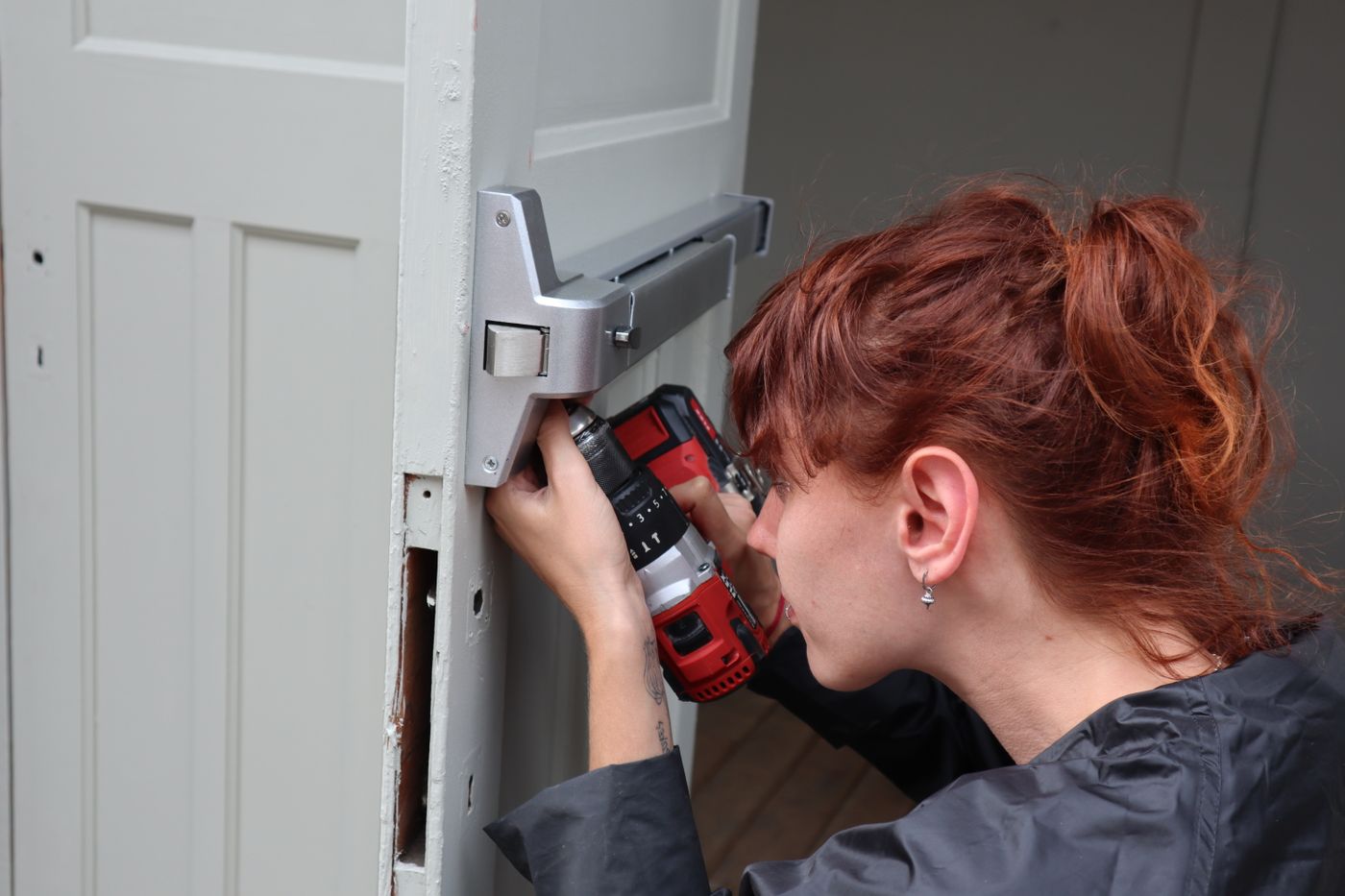
01 Bore from both sides
This is the whole technique. The Home Depot's own hardware instructions:
"To avoid splintering or marring the door, drill from one side of the door until the pilot bit comes through the door. Then finish drilling from the other side of the door, using the hole made by the pilot bit as your guide."
Fine Homebuilding says the same. Stop as the pilot bit pokes through, move to the other side, drill back.
The bit then exits into its own hole instead of through the veneer.
02 Get the depth right
The edge bore has to be deeper than people expect. Home Depot: drill a full 3 1/2" deep for a 2 3/8" latch, and at least 3 3/4" for a 2 3/4" backset latch.
03 Tape the cut line
If you are trimming rather than boring, JELD-WEN says to "stick masking tape along the cut line to each face of the slab." Cut with a fine-toothed circular saw, then finish the width with a plane.
How much you can trim
Less than people assume. JELD-WEN, for US interior slabs:
"A hollow or solid core molded and flush slab can be trimmed, if needed. A maximum of 1/4" can be trimmed from each edge. For the best appearance, trim an equal amount from opposite sides."
Lowe's publishes the identical instruction for its ReliaBilt slabs. JELD-WEN adds that trimming any other type of slab is not recommended.
A quarter inch is not much. Take more off a long edge and you are into the stile — and on the lock side, into the block the handle depends on.
Do OKUN handles fit veneer doors?
Yes, and here is the spec-by-spec reason rather than the assurance.
| US standard | Source | OKUN |
|---|---|---|
| Cross bore 2 1/8" | Home Depot, Schlage, JELD-WEN | 2 1/8" |
| Edge bore 1" | Home Depot, JELD-WEN | 1" |
| Backset 2 3/8" or 2 3/4" | Home Depot, Schlage | Adjustable — both |
| Door thickness 1 3/8" to 1 3/4" | Steves, Doormerica | 1 3/8" to 1 3/4" |
| Bore height ~36" from the floor | JELD-WEN, Home Depot | No constraint |
| Lock block on either edge, or both | JELD-WEN, Lynden, NYC HPD | Reversible — either hand |
Three of those rows do real work on a veneer door.
The adjustable backset. You do not need to know the stile width before you order. If the door turns out narrow-stiled, set the latch to 2 3/8" and bore once. A fixed 2 3/4" latch on that door is a wasted slab.
The reversible handle. The lock block decides which edge takes the latch. On a US door that could be either edge, or both. Reversible hardware means the door's construction never becomes a reorder.
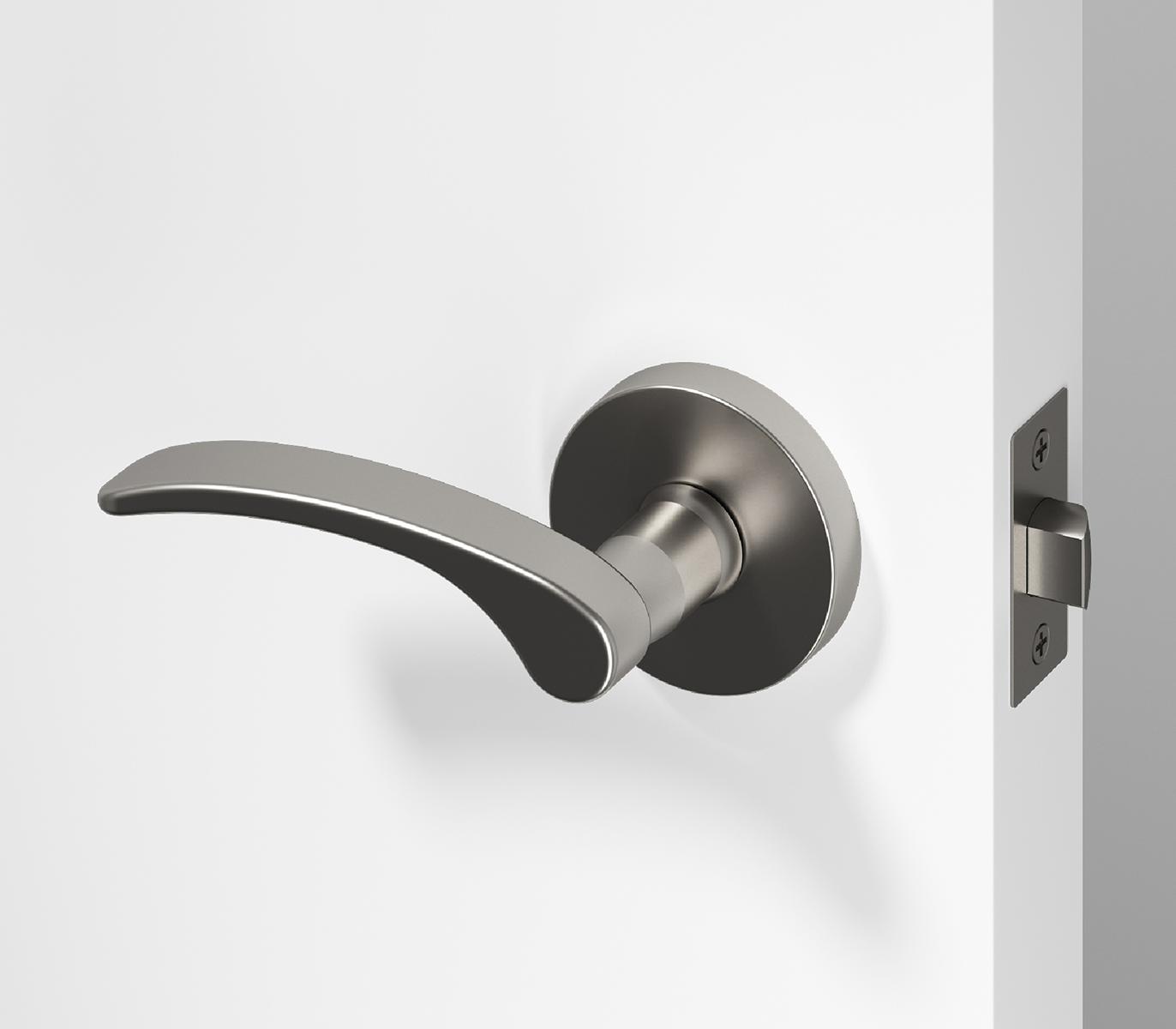
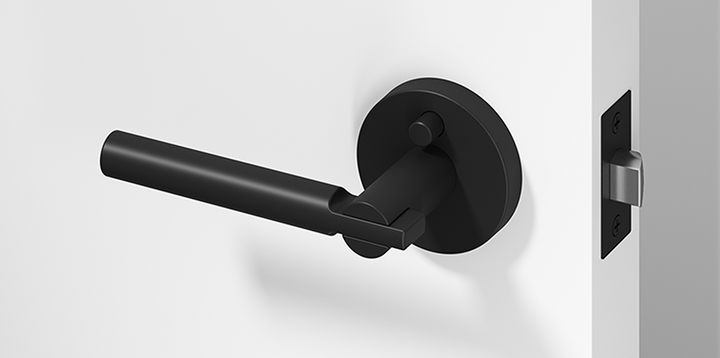
The concealed-mount rosette. OKUN's rose is 2 5/8" and mounts without visible screws. It covers the 2 1/8" bore with a quarter inch of margin all round. Nothing is driven through the veneer beside the hole.
On a veneer door you get one attempt. Every one of those specs exists so you do not need a second.
how to measure backset, thickness and handing · the 15-minute install · matching finishes to door styles
What OKUN makes
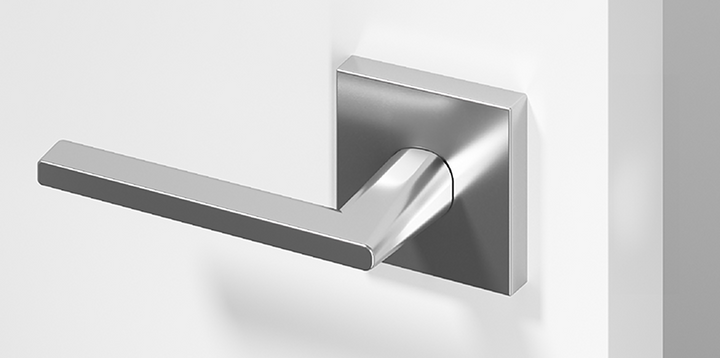
Twelve lever collections — Stark, Valli, Zen, Arc, Dune, Brio, Halo, Mirra, Quadra, Muse, Terra and Brook — in matte black, brushed nickel, chrome and champagne brushed gold.
Every one is reversible, every one has the adjustable 2 3/8" or 2 3/4" backset, and every one uses the 2 5/8" concealed-mount rosette. Privacy $59.99, passage $49.99, dummy $29.99.
Which means on a veneer door you bore once, fit either hand, and put nothing through the face.
Read the top edge. Bore from both sides. Fit it once.
Premium door handles for less.
Twelve collections. Four finishes. Reversible, adjustable, concealed.
Answers
Will OKUN door handles fit a veneer door?
Yes. OKUN levers use the US standard 2 1/8" cross bore and 1" edge bore, and fit doors 1 3/8" to 1 3/4" thick. The backset adjusts between 2 3/8" and 2 3/4", and every lever is reversible — so whichever edge holds the lock block, the same set fits.
What is a lock block in a door?
A solid section built into the stile of a hollow-core door at handle height, so a latch and handle have something to fix into. US manufacturers publish sizes from 3" x 7 1/2" up to 3" x 20", usually particleboard.
How do I find the lock block?
Read the top edge. JELD-WEN stamps it with an arrow and the letters LB, and the arrow points to the blocked edge. A stamp on both sides means both edges are blocked. Most other US makers publish no convention, so if the stamp is missing, buy a pre-bored slab rather than guess.
Do hollow-core doors have one lock block or two?
Both exist in the US. Lynden Door puts two in all book edge doors, and New York City's housing specification requires a block on each side. Other manufacturers fit one. The top-edge stamp is what tells you.
Are veneer doors hollow or solid?
Both are sold, but most residential veneer doors are hollow-core — a cellular honeycomb inside a frame of stiles and rails, faced with veneer bonded to fiberboard. Solid-core versions use a particleboard core instead.
How thick is the veneer on an interior door?
US architectural specifications call for 1/50 of an inch after factory sanding — 0.020", about half a millimeter. A credit card is roughly three times thicker.
How do you drill a veneer door without chipping it?
Bore from one face until the pilot bit breaks through, then finish from the opposite side using that pilot hole as your guide. The Home Depot's own instructions specify this to avoid splintering. Drill the edge bore a full 3 1/2" deep for a 2 3/8" latch, 3 3/4" for a 2 3/4" one.
Can you trim a veneer door?
A maximum of 1/4" from each edge on hollow or solid core molded and flush slabs, per JELD-WEN and Lowe's ReliaBilt instructions. Trim an equal amount from opposite sides, tape the cut line to reduce chipping, and never trim the top — that is where the lock block stamp is.
Does the stile width affect which backset I can use?
Yes, and it is the most missed detail. Steves & Sons specifies a minimum 3 11/16" stile for a 2 3/8" backset and 4 1/16" for 2 3/4", both with a standard 2 1/8" bore. A narrow stile cannot take the deeper backset — which is why an adjustable latch is worth having.
Sources: JELD-WEN, Installation Instructions for Interior Door Slabs (JII110) · The Home Depot, door hardware installation instructions · Lowe's / ReliaBilt interior door slab instructions · Steves & Sons product specification · Doormerica / ABS Manufacturing, American Series door specifications · Lynden Door, Features and Benefits · Oshkosh Door Company architectural guide specification · NYC Department of Housing Preservation and Development, Hollow Core Wood Doors · Fine Homebuilding · Schlage.