

What Makes an OKUN Door Knob Different
Almost everyone who writes to us calls them knobs. Here's what's actually in one — the weight, the hidden screws, the finish — and what people say after they've lived with a set.
Four things set an OKUN door knob apart. It is solid brass rather than hollow zinc alloy, so it has noticeable weight in the hand — a single privacy set weighs 2.6 lb. It uses a concealed-mount rosette with no screws visible on the finished face. It ships as a complete kit — both levers, an adjustable latch, strike plate, mounting hardware, Allen wrench and the emergency unlock tool. And it comes in eleven collections across four PVD finishes, so every door in a house can match.
Sets run $29.99 for dummy, $49.99 for passage and $59.99 for privacy, with 1-, 2- and 6-packs. Designed in New York City and sold direct, which is how the price stays where it is.

First, About the Word "Knob"
We answer customer emails every day, and a pattern shows up in almost all of them: people call our hardware door knobs. Not levers, not handles. Knobs. So when someone searches for a modern door knob, an OKUN lever is usually what they're picturing.
Technically, a knob is round and a lever is the horizontal bar you push down, and what OKUN makes is a lever. But in American English "door knob" long ago stopped meaning the shape and started meaning the category — the thing on the door that opens the door. Nobody says "please replace the lever on the guest bathroom." They say the knob is loose.
So this article uses both words the way our customers do. When you see door knob here, it means the hardware on your interior doors, whichever shape it happens to be. If you want the strict distinction and where each one genuinely suits a room better, that's in our complete guide to door knobs and levers.
Why an OKUN Door Knob Feels Heavier
This is the single most common reaction in our reviews, and it's never what people expected to write about. They open the box, pick the handle up, and are surprised by how much it weighs.
"Shocked at how heavy it was" — the most-repeated sentence in our review inbox.
That heft isn't padding. Most hardware in the $20–$50 range is zamak — a zinc alloy cast hollow to save material — with a thin plated coating over it. It looks fine in a photograph and feels like nothing in your hand. OKUN levers are solid brass, and brass is roughly twice as dense as the alloy it's competing with.
Weight matters more than it sounds like it should, because it's the part your body registers before your eyes do. A hollow handle telegraphs cheapness through your palm every time you touch it. A solid one just feels settled. It's also why the movement is smoother: there's more mass damping the return spring, so the lever doesn't snap back with that tinny rattle.
If you want the number: a single Halo privacy set weighs 2.6 lb in the box. That is not a figure most hardware brands are keen to publish.


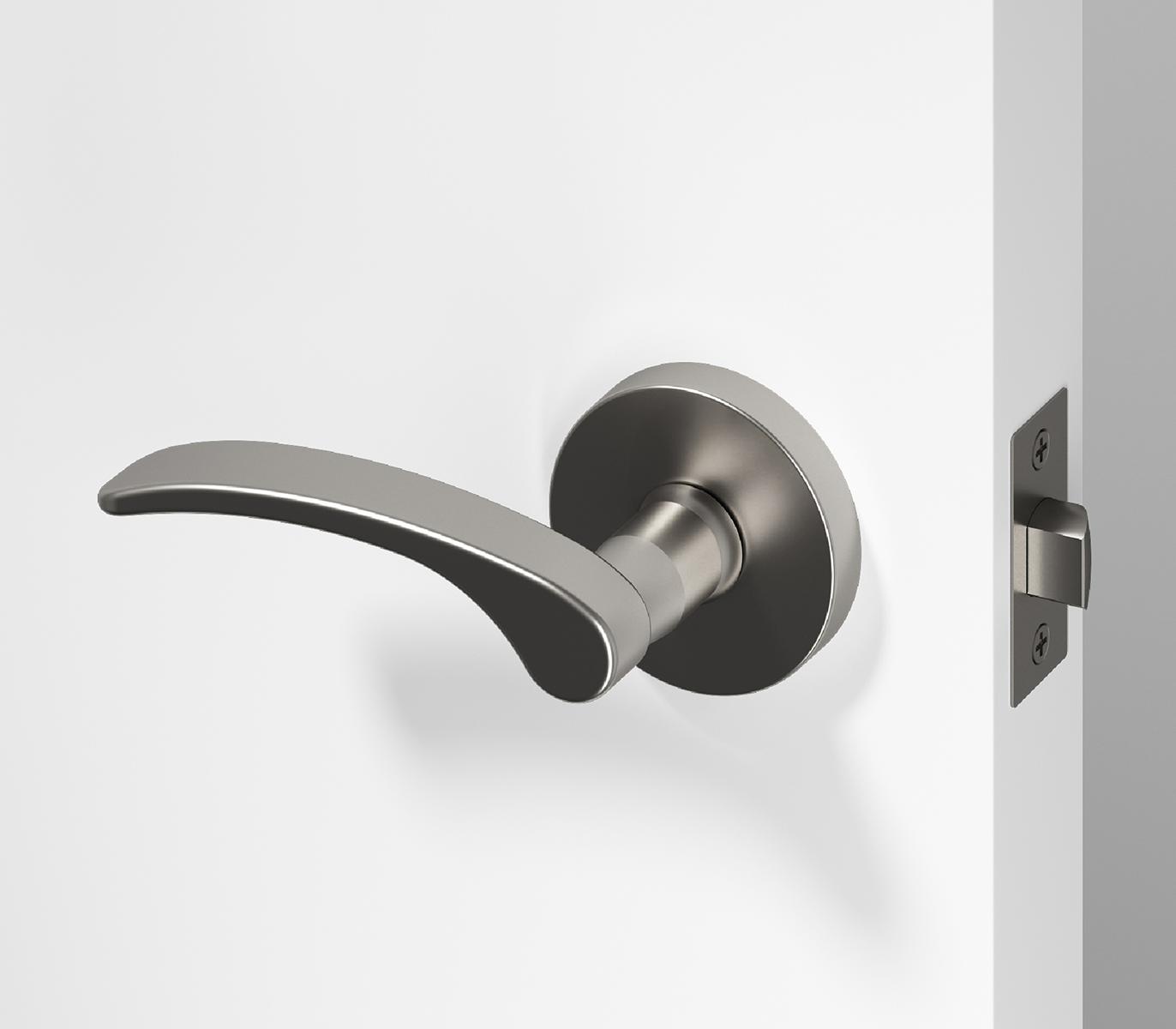
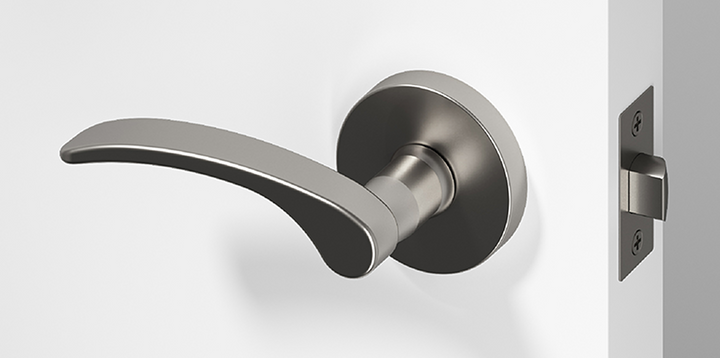
The Halo profile: an elongated lever with a tapered end, projecting at 45 degrees from the door face.
The Door Knob Detail You Can't See: Concealed Screws
Stand three feet from a builder-grade door knob and the first thing your eye finds is two Phillips-head screws sitting on the backplate. Once you've noticed them you can't stop noticing them, in every rental and every hallway.
Every OKUN handle uses a concealed-mount rosette. The fasteners sit behind the trim ring, so the finished face is an uninterrupted disc of metal. It's a small manufacturing difference and a large visual one — it's most of what separates hardware that reads as architectural from hardware that reads as builder-grade, and it's the detail specifiers look for first.
It also means the rosette can be smaller. OKUN's is 2 5/8" across — enough to cover a standard 2 1/8" bore and nothing more. Exposed-screw designs need extra diameter just to give the screws somewhere to land.
One Handle, Either Door, Everything Included
Two practical things that sound like small print until you're standing on a stepladder.
Every OKUN lever is reversible. The same set fits a left-hand or right-hand door, so you don't have to know your door's handing before you order, and leftover sets can move to any other door in the house. The adjustable latch covers both standard backsets — 2 3/8" and 2 3/4" — which removes the other measurement people get wrong.
The box is complete. Both levers, adjustable latch, strike plate, six screws, Allen wrench, and on privacy sets the emergency unlock tool. No second trip, no separate latch purchase, no discovering at 9pm that the strike plate wasn't included.


Shop by function: privacy locks, passage opens, dummy is a fixed decorative pull — all three built the same way.
Eleven Door Knob Collections, One System
Most brands give you a shape and a price tier. OKUN runs one construction standard across the whole range and varies only the lever profile — which means you can put a different silhouette on a bedroom door than on a hallway door and still have them read as a matched set, because the rosette, the finish and the mechanism are identical.
| Profile | Collections | Reads as |
|---|---|---|
| Slim rectangular | Stark, Valli, Dune, Muse | Clean and minimalist — the safest choice in a modern interior |
| Cylindrical | Zen, Brio, Terra | Softer contemporary; rounder in the hand |
| Elongated tapered | Halo | A 5 1/4" lever that holds its own on tall or wide doors |
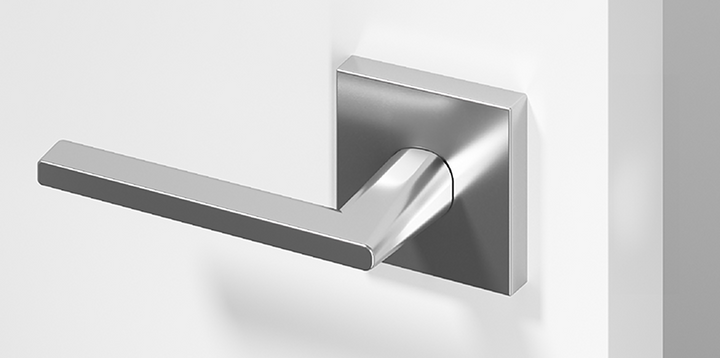
| Square backplate | Mirra, Quadra | Architectural geometry, for interiors with strong lines |
| Curved | Arc, Brook | A gentler line that suits transitional rooms |
Lever lengths run roughly 4 1/2" to 5 1/4" depending on collection, all on the same 2 5/8" rosette at a 45-degree projection. Every collection comes in all three functions, so a single profile can carry a whole floor.
Four Finishes, and Why PVD Matters
Finish is where cheap hardware fails visibly. Standard electroplating is a coating sitting on the surface; after a couple of years of daily handling it thins at the contact points and goes patchy exactly where your hand lands. PVD — physical vapour deposition — bonds the finish at a molecular level instead, which is why it holds its appearance far longer under the same use.
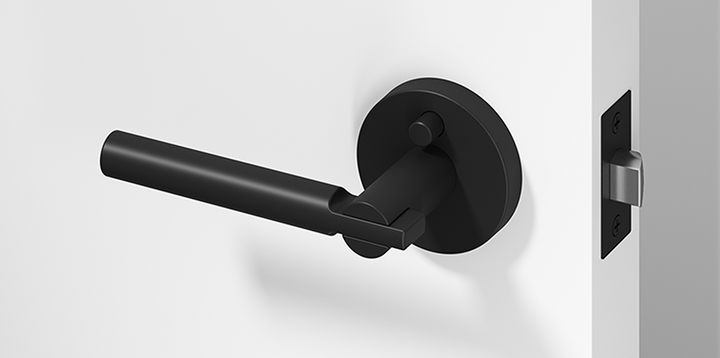
The practical advice is unglamorous but it's the thing that makes a house look designed: pick one finish and run it through every door. All four are available across all eleven collections and all three functions, which is the entire point of the range. Matte black is the most requested and reads boldest against white doors — more on that finish here. Brushed nickel is the most forgiving and hides fingerprints best. Chrome stays bright. Champagne brushed gold gives warmth without the dated brass look.

What OKUN Door Knobs Cost
| Function | Price | What's inside |
|---|---|---|
| Dummy | $29.99 | Fixed decorative lever, no latch mechanism |
| Passage | $49.99 | Turning lever, adjustable latch, strike, no lock |
| Privacy | $59.99 | Push-button lock, emergency release, unlock tool |
The price tracks the mechanism, not the styling — a dummy costs less because there's less machine inside it, not because it's a lesser-looking handle. Architectural brands at a comparable design level typically run well past $100 per opening, which is the gap selling direct is meant to close. If you want the head-to-head, we've written a full comparison against Baldwin, Schlage and Emtek.
2-packs and 6-packs exist because whole-home projects are the common case: a typical three-bedroom needs four to six privacy sets plus passage hardware for hallways and closets.
What Buyers Say About OKUN Door Knobs
Three themes come up again and again, and none of them are the things a spec sheet leads with.
Surprised by the weight on unboxing — called it a solid piece, smooth to operate, and easy to line up during install. Now replacing the rest of the house.
Praised how the reversible fit lets a set move between doors, and called the matte black finish a real upgrade over what was there before.
Started with hardware that had gone wobbly and squeaky, then swapped the whole house at once — dummy on closets, passage in hallways, privacy on bedrooms and baths.
The third one is the pattern we see most in customer service. People rarely buy one handle. They buy one, live with it for a week, and then order the rest of the house — which is also why certain finish and pack combinations sell out, and why buyers regularly tell us they'd rather wait for a restock than substitute something else. That's a strange compliment to receive about door hardware, and we don't take it lightly.
Will an OKUN Door Knob Fit Your Doors?
Almost certainly. American interior doors are unusually standardized, and OKUN is built around those standards.
- Bore — 2 1/8", the US standard hole through the door face.
- Backset — 2 3/8" or 2 3/4" from door edge to bore centre. The adjustable latch handles either, which is the single most common fit worry resolved.
- Door thickness — 1 3/8" through 1 3/4".
- Handing — none needed. Reversible across the range.
If your doors are in those ranges you're swapping hardware, not modifying a door: a screwdriver, about fifteen minutes, no drilling. The step-by-step install guide covers it, and every set ships with a manual.
Key Takeaways
Premium Door Handles for Less
Solid brass levers designed in New York — Matte Black, Brushed Nickel, Chrome and Champagne Brushed Gold, across eleven collections and every function. Concealed-mount rosettes, adjustable latches, everything in the box.
Shop Door HardwareFrequently Asked Questions
Are OKUN door knobs solid or hollow?
Solid. OKUN levers are made of solid brass rather than the hollow zinc alloy (zamak) used in most builder-grade hardware, which is why buyers consistently comment on the unexpected weight when they unbox a set. The extra mass also smooths the return spring, so the lever doesn't rattle back into place.
What is a concealed-mount door knob?
A concealed-mount handle hides its mounting screws behind the rosette, so nothing is visible on the finished face of the door. Builder-grade hardware leaves two exposed Phillips-head screws on the backplate. Every OKUN handle is concealed-mount, and the rosette measures 2 5/8" across.
Do OKUN door knobs fit standard American doors?
Yes, in nearly all cases. They fit a standard 2 1/8" bore, doors 1 3/8" to 1 3/4" thick, and either the 2 3/8" or 2 3/4" backset via an adjustable latch. Every lever is reversible, so the same set works on a left- or right-hand door with no handing decision at checkout.
How much do OKUN door knobs cost?
Dummy sets are $29.99, passage sets are $49.99 and privacy sets are $59.99, with 1-, 2- and 6-pack options for whole-home projects. The price difference reflects the mechanism inside rather than the design, and comparable architectural brands typically run well over $100 per opening.
What's included in the box?
Both levers, an adjustable latch, a strike plate, mounting screws, an Allen wrench and an installation manual. Privacy sets also include the emergency unlock tool for the exterior pinhole release. Nothing else needs to be bought separately.
Why do some OKUN finishes and pack sizes sell out?
Because most customers buy for a whole house rather than a single door, multi-packs and popular finishes move fastest. Availability varies by collection, finish and pack size — the product page shows live stock for each combination, and many buyers choose to wait for a restock of a specific finish rather than break the match across their doors.
Is a door knob the same as a door lever?
Strictly, a knob is round and turns in the hand while a lever is a horizontal handle you press down. In everyday American usage "door knob" refers to interior door hardware of either shape. OKUN makes levers, which most customers refer to as knobs — the function options and finishes are identical either way.