

The bedroom door is the one you open half-asleep. At two in the morning, in the dark, trying not to wake anyone, you find out exactly what kind of handle you bought. Builder-grade hardware is chosen for the day a house is sold. This is about the twenty years after.
This isn’t a guide to how privacy locks work (that’s Lockable Door Handles: The Complete Guide) or a list of picks by room (that’s Best Lockable Door Handles for Every Room). It answers a question customers ask us all the time: why spend more on the handle for a bedroom or bathroom door when the cheap one locks too?
Quick Answer
Why are OKUN levers a better choice for bedroom and bathroom privacy?
Because privacy doors are the ones you use with sleepy, wet or full hands, and that’s where builder-grade hardware shows its shortcuts. An OKUN privacy lever is solid metal, so it returns without the rattle of a hollow handle. The push-button locks with one thumb and releases when you turn the inside lever, and a pinhole outside opens it in an emergency. Screws are hidden, and the PVD finish is made to hold up where hands touch it every day.
Every OKUN design comes as a lockable set for $59.99, or about $48 a door in a 6-pack.
- Free delivery3–5 days
- All in the boxLatch, strike, screws, release tool
- 15-minute fitStandard pre-bored doors
- ReversibleLeft- or right-hand doors

Key Takeaways
- Privacy doors get the hardest use. Night trips, wet hands, kids and guests: the bedroom and bath doors are where a handle earns its keep.
- Weight is the difference you feel first. Solid metal returns smoothly; hollow zinc rattles and loosens.
- One thumb to lock, one turn to leave. A push-button that releases from the inside lever can’t lock you out by accident.
- A lever works when your hands don’t. Accessibility guidance favors hardware that needs no pinching or wrist-twisting, which rules out round knobs.
- It costs about $10 more than a non-locking door. $59.99 a set, about $48 a door in packs, with every part in the box.
What does a bedroom door actually ask of its handle?
More than any other door in the house. A bedroom or bathroom handle has to lock reliably, unlock without thought, and work in the dark with wet, sleepy or full hands.
A hallway closet gets opened a few times a day by someone wide awake. A bedroom door gets opened at 2 a.m., with a towel in one hand, by a four-year-old, by a guest who’s never seen it before. When we designed our privacy sets, we started from those moments rather than from a spec sheet:
The moments that test a privacy handle
| Moment | What your hand is doing | What the handle needs |
|---|---|---|
| 2 a.m. bathroom trip | Feeling for it in the dark | A lever you find by touch, that returns quietly |
| Out of the shower | Wet, slippery fingers | No grip-and-twist; press down and go |
| Arms full of laundry | Nothing free but an elbow | A lever long enough to push with your arm |
| Locking for privacy | One thumb, no looking | A button that’s easy to find and press |
| Leaving the room | Already walking out | A lock that releases when you turn the inside lever |
| A child locks in | A parent outside, worried | A pinhole release that works in seconds |
None of that is exotic. But you can only feel the difference once a handle is on the door, which is exactly why the cheapest set in the aisle keeps ending up there.
How is an OKUN privacy lever different from builder-grade?
Builder-grade privacy sets lock and fit, but they’re usually hollow, show their screws, and use a lock you have to pinch. OKUN privacy levers are solid metal, mount with hidden screws, and lock with a one-thumb push-button.
To be fair to builder-grade: it does the job it was bought for, usually by someone who wasn’t going to live with it. A few terms first, because they come up below:
- Builder-grade
- The entry-level hardware a contractor fits by default: chosen on price, sold in multipacks, rarely chosen by the people who live with it.
- Privacy function
- A handle that locks from inside with a button or turn, and opens from outside with an emergency release. No key.
- Concealed mount
- The screws holding the handle sit behind the round plate (the rose), so none show on the face.
- PVD finish
- Physical vapor deposition: a finish bonded to the metal in a vacuum chamber, rather than a coating plated on top.
Builder-grade privacy set vs OKUN privacy set
| What to check | Typical builder-grade | OKUN privacy lever |
|---|---|---|
| Material | Hollow zinc alloy with a thin plated coat | Solid metal; a Halo privacy set weighs 2.6 lb boxed |
| Screws | Two Phillips heads on the face of the rose | Concealed behind a 2 5/8″ rose |
| Lock | Often a small turn-button you pinch | Push-button; releases when the inside lever turns |
| Emergency release | Varies; sometimes a slot needing a coin | Pinhole outside, tool included in the box |
| Finish | Electroplate that wears where hands land | PVD in four colors |
| Fit | Fixed backset, sometimes handed | 2 3/8″ or 2 3/4″ adjustable, reversible |
| Matching set | Shapes change between lock types | Same lever in privacy, passage and dummy |
How we compared: the builder-grade column describes traits common to entry-level privacy sets in US home-center aisles; the OKUN column comes from OKUN product data, October 2026.
 Hidden screws
 One-thumb lock
For the wider picture across every door in the house, we compared the categories in Architectural Door Handles vs Builder-Grade. On a privacy door, the lock itself is what tips it.
Every OKUN lever comes with a privacy lock, in every finish.
Shop privacy handlesWhy does ergonomics matter more on a privacy door?
Because it’s the door you use when you’re least able to fiddle with it. A lever, a long enough handle and a push-button lock all work without grip strength, and that’s what counts at night or with wet hands.
The lever, not the knob. A knob needs a dry hand that can grip and twist. A lever needs a push, from fingers, a wrist or an elbow. The U.S. Access Board’s guide to the ADA Standards says operable parts shouldn’t require tight grasping, pinching or twisting of the wrist, and notes that round door knobs fail that test1. Homes don’t have to follow it, but it’s a good test of what’s easy for everyone. We wrote more about this in Easier-to-Use Door Handles.
Push, don’t pinch. The same guide treats push buttons as acceptable controls, while small turn-pieces that must be pinched are the kind of part it flags1. That’s the difference between an OKUN push-button and the turn-button on many cheaper privacy sets.
Length is leverage. A longer lever needs less force to turn the latch, the same way a longer wrench turns a bolt more easily. OKUN levers run from 4 3/8″ to 5 1/4″; the Halo, the longest, is the lightest to open.
A lock that lets you leave. Turn the inside lever and the button pops out, so nobody locks a door behind them by mistake.

Why does a heavier handle feel better on a bedroom door?
Weight steadies the lever. A solid metal handle settles back into place as the spring returns it; a light, hollow one snaps up, rattles and works loose over time.
When people unbox an OKUN set, the first thing they mention is the weight. That’s not decoration. Most hardware at the lower end of the market is zinc alloy cast hollow with a thin coating; it looks fine in a photo and feels like nothing in your hand.
A solid metal lever has real mass to it. That weight steadies the lever as the spring returns it, so it settles back instead of snapping up with a tinny rattle. It also means the lever doesn’t droop the way a light handle does after a few years of being yanked on.
On a bedroom door that matters more than anywhere. It’s the one you close carefully once a child is asleep, and you’ll hear every clatter.
You notice a cheap handle with your hand before you notice it with your eyes.
Does a door handle really change how a bedroom looks?
Yes. In most bedrooms the door faces the bed, so the handle is the last thing you see at night and the first in the morning. One simple shape in a finish that echoes the room makes it look finished.

It’s small, but it sits at eye level next to everything you chose with care: the bed frame, the lamp, the side table.
That’s why we keep OKUN levers simple: one clear shape, no visible screws, a 2 5/8″ rose that covers the hole and nothing more. Then pick a finish that echoes something already in the room: champagne gold with warm wood, matte black with black frames, brushed nickel with grey linen.
And because every design comes in privacy, passage and dummy versions, the bedroom door, the closet and the hallway can all match. Here are four we’d choose for how they feel in the hand:

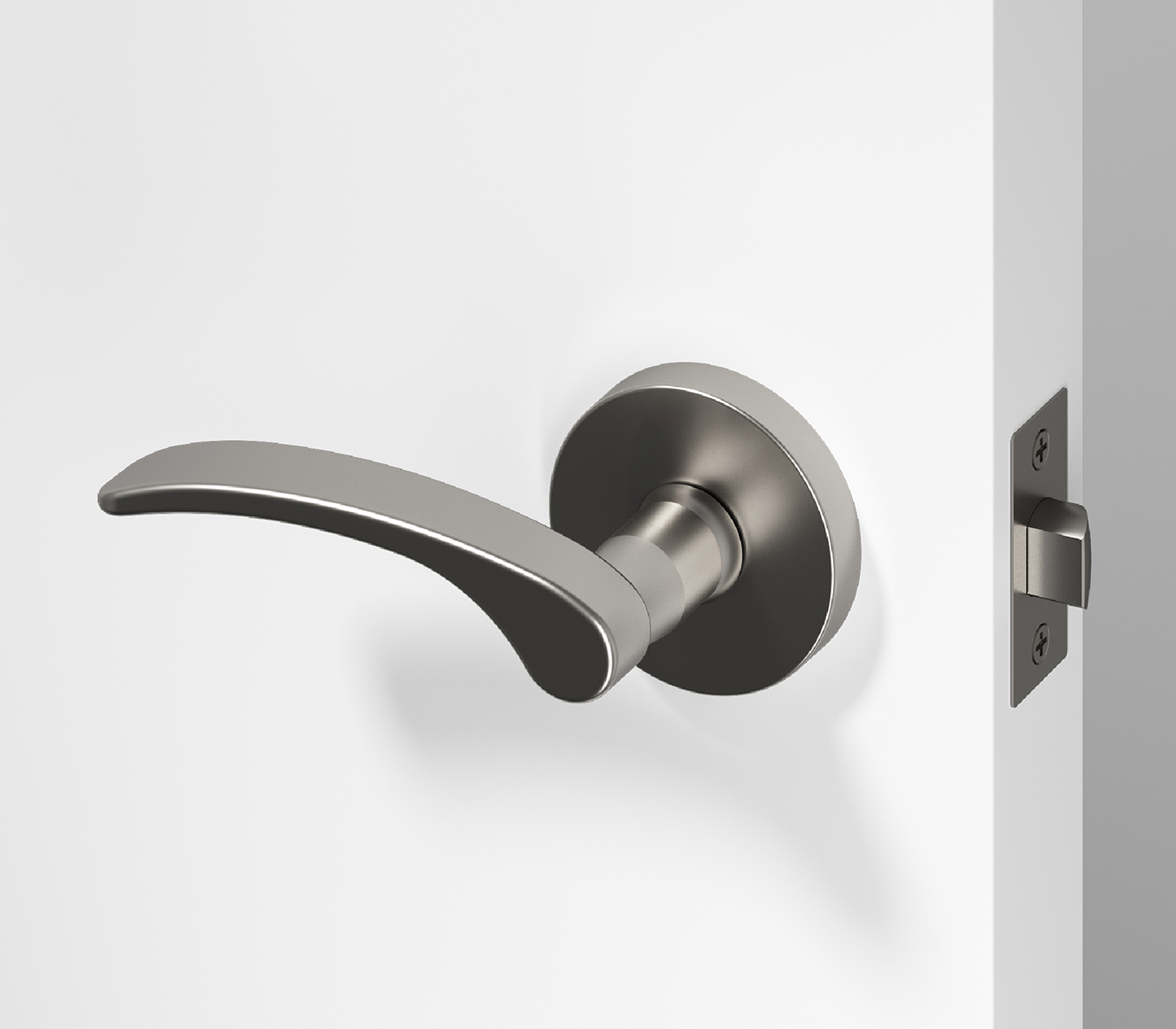
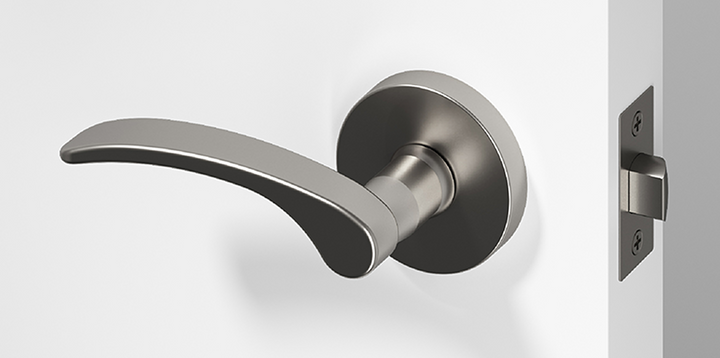
Rounded, no hard edges
Arc privacy
A softly radiused grip that’s comfortable for every hand in the house, small ones included.
4 finishes
$59.99 · about $48 a door in 6-packs

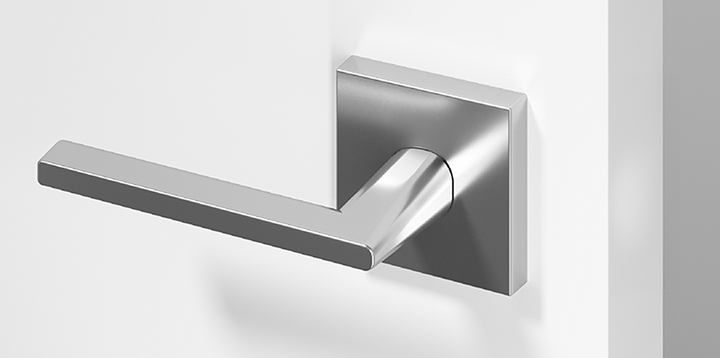
5 1/4″ long taper
Halo privacy
The longest OKUN lever, so it takes the least effort to open, and it suits a tall primary-suite door.
4 finishes
$59.99 · about $48 a door in 6-packs

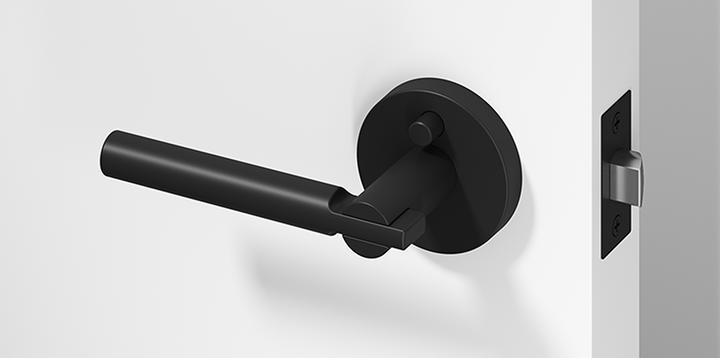
Balanced cylinder
Brio privacy
A round bar that sits naturally in a closed hand. The easy all-rounder for bedrooms and baths alike.
4 finishes
$59.99 · about $48 a door in 6-packs

Compact 4 1/2″
Zen privacy
Shorter and quiet-looking, for narrow en-suite doors where a long lever would crowd the frame.
4 finishes
$59.99 · about $48 a door in 6-packs
Should the en-suite bathroom door match the bedroom door?
Yes. Use the same lever on both, with a privacy set on the bathroom door and the button facing into the bathroom. From the bed you see both doors, and two different shapes side by side look like an afterthought.
The finish is the one place to think twice. Brushed nickel and matte black hide water spots best; chrome matches most taps but shows them sooner. We go deeper on bathrooms in Best Door Levers for Modern Bathrooms and on the two silver tones in Brushed Nickel vs Chrome.
Doing the primary bedroom and its bathroom? A 2-pack is $107.99.
Choose your pairThe short version
A builder-grade handle locks. An OKUN privacy lever locks, and also feels solid in the dark, opens with a wet hand or an elbow, releases on its way out, and still looks right on the door you see every morning. For about $10 more than not having a lock at all.
Bedroom & Bathroom Privacy
Feel the difference on the first night.
Solid metal levers with push-button privacy, concealed screws and the emergency tool in every box. $59.99 a set, about $48 a door in 6-packs, with free 3–5 day delivery.
Shop Privacy HandlesSee Best-SellersFrequently asked questions
Are OKUN door handles better than builder-grade?
For doors you use every day, yes. Builder-grade privacy sets are usually hollow zinc with exposed screws and a plated finish that wears where your hand lands. OKUN privacy levers are solid metal, mount with hidden screws, and use a PVD finish, so they feel steadier and keep their looks longer. Both will lock; the difference is how they feel and age.
What does “builder-grade” door hardware mean?
Builder-grade means the entry-level hardware a contractor fits by default, chosen mainly on price and bought in bulk. It works, but it’s typically hollow cast metal with a thin plated finish and visible screws, and it’s rarely chosen by the people who will use it every day.
Is a push-button or turn-button lock better on a bedroom door?
A push-button is easier. You press it with one thumb without looking, and on OKUN sets it pops out when you turn the inside lever, so you can’t lock the door behind you by accident. A turn-button needs a pinch-and-twist that’s harder with wet or sleepy hands, and it stays locked until someone turns it back.
Why do cheap door handles feel loose or rattle?
Mostly because they’re light. Hollow zinc levers have little mass to steady the spring, so they snap back and rattle, and the thin mounting works loose with use. A solid metal lever settles back smoothly. If an existing handle is loose, our guide to fixing a loose door handle covers the quick tightening fix first.
Are lever handles better than knobs for bedrooms and bathrooms?
For privacy rooms, generally yes. A lever opens with a push from fingers, a wrist or an elbow, so it works with wet hands, full arms or in the dark. A knob needs a firm, dry grip and a twist, which is why ADA accessibility guidance treats round knobs as hard to use. Levers are also easier for children and older adults.
Should a bathroom off the bedroom have a privacy lock?
Yes. An en-suite bathroom should have a privacy lever with the push-button facing into the bathroom and the pinhole release on the bedroom side. Use the same lever and finish as the bedroom door, so both read as one design from the bed.
Is it worth upgrading bedroom door handles if the old ones still work?
If they lock reliably and feel solid, there’s no rush. Upgrade when a handle wobbles, the finish has worn through, the lock sticks, or it simply doesn’t match the room you’ve made. OKUN sets fit standard pre-bored doors, so the swap takes about fifteen minutes per door with a screwdriver.
Keep Reading
Sources
- U.S. Access Board, Guide to the ADA Standards: Operable Parts (§309.4)
- OKUN privacy product data: prices, pack sizes, finishes, lever lengths and set weight, October 2026
OKUN handles are made for homes and are not marketed or certified as ADA-compliant; the ADA guide is cited as a test of ease of use. Photos: Burst by Shopify, OKUN.
OkunThe little details make a big difference. Designed in NYC.


